
Review · QUEBEC CITY
Quebec City Hop-On Hop-Off
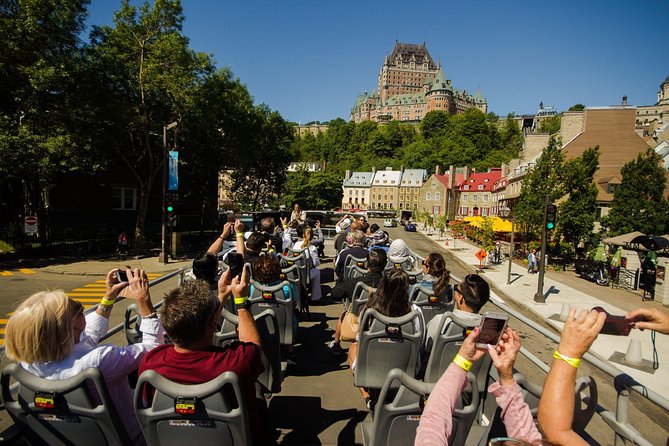
Quebec City’s red, open-top double-decker bus gives you a quick look at both the old town and the newer districts beyond it. The full circuit takes about two hours, and you can hop off at 15 stops for places such as the Citadelle, the Old Port, Parliament Hill, and the Plains of Abraham.
I like the wide views from the upper deck, especially when the bus climbs around Cape Diamond and the fortified old city. I also like the flexible 1- or 2-day pass, plus recorded commentary in 10 languages, which helps you get your bearings before exploring on foot.
The main catch is bus frequency. On busy cruise-ship days, full buses and long waits can defeat the hop-on hop-off idea, so this works best when you have extra time and are not relying on it for a tight schedule.
Key points to know before you board
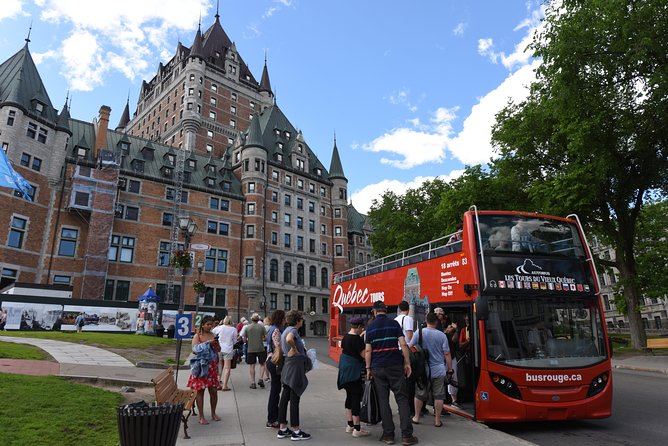
- Fifteen stops cover more than Old Québec: The route reaches Saint-Roch, the Old Port, Parliament Hill, the Plains of Abraham, the Citadelle, Grande Allée, and Saint-Jean-Baptiste.
- The complete circuit takes about two hours: Ride the whole loop first if you want an overview, then decide where to get off.
- The upper deck offers the best views: It is open to the sky, so bring a layer for cool or windy weather.
- Audio commentary is available in 10 languages: Earphones let you follow the city’s past, present, and future while the bus moves between stops.
- A 2-day pass is useful only if buses are running reliably: It can work well for spreading out your sightseeing, but crowded buses have made reboarding difficult on some days.
- Cruise-ship days need caution: Heavy demand has caused waits of 45 minutes to more than two hours, with some buses arriving full.
What the Quebec City bus tour is really good at
This is a sightseeing and orientation ride rather than a substitute for exploring Quebec City on foot. The bus lets you see how the city fits together: the fortified old town above the river, the Old Port below it, the parliamentary district to the west, and neighborhoods such as Saint-Roch and Saint-Jean-Baptiste farther inland.
For a first visit, that overview has real value. You can spot the places you want to return to, learn the basic layout, and avoid spending your first morning wandering without a plan. I especially like doing one complete circuit before hopping off. You get a sense of distance and can then use the second loop for selected stops.
The route is advertised at about two hours, though the actual experience depends on traffic, boarding delays, road closures, and how long buses pause at major stops. Some rides may take a little over an hour in favorable conditions, while crowded days can stretch the outing much longer.
The recorded audio is one of the stronger parts of the experience. It covers the city’s development and major landmarks as you go, rather than leaving you with nothing but a driver’s directions. Still, the quality can vary. Some passengers have found that certain commentary units did not work, and the narration sometimes gives a fact without explaining its larger meaning.
A few more Quebec City half-days to weigh up
- Quebec City Walking Tour
★ 5.0 · 4,716 reviews - Quebec City: Guided Tour of Fairmont Le Château Frontenac
★ 4.7 · 3,027 reviews - Québec City: Guided Sightseeing River Cruise
★ 4.4 · 3,000 reviews
The first loop: Old Québec, Place Royale, and the riverfront
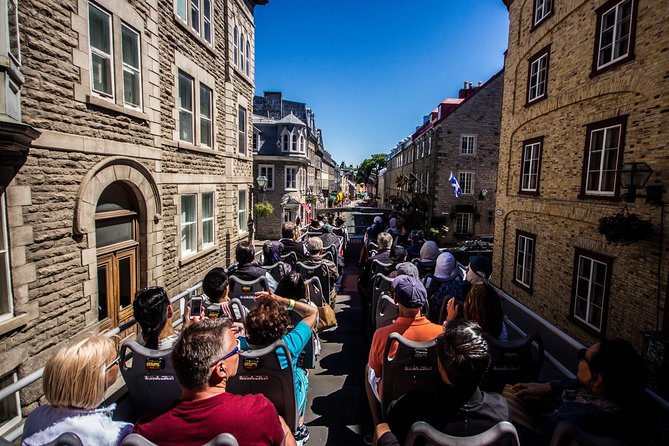
Stop 1, the Fort Museum at Place d’Armes, puts you right beside the historic core. From here, you are close to the Musée du Fort and the Musée de l’Amérique francophone. This is a practical starting point because Place d’Armes gives you immediate access to the old city’s main streets.
Stop 2 at de la Couronne takes you into Quartier Saint-Roch. This district is useful if you want shopping and trendy restaurants beyond the most visited streets of Old Québec. It also shows you a more modern side of the city, though it is less concentrated with major sights than the old town.
At Stop 3, on Dalhousie Street, you are near the Musée de la civilisation, Place de la FAO, and the waterfront promenade. The museum is a good reason to get off if you want a fuller look at Quebec culture and society. The quays are also a pleasant place to walk, with a different feel from the steep streets above.
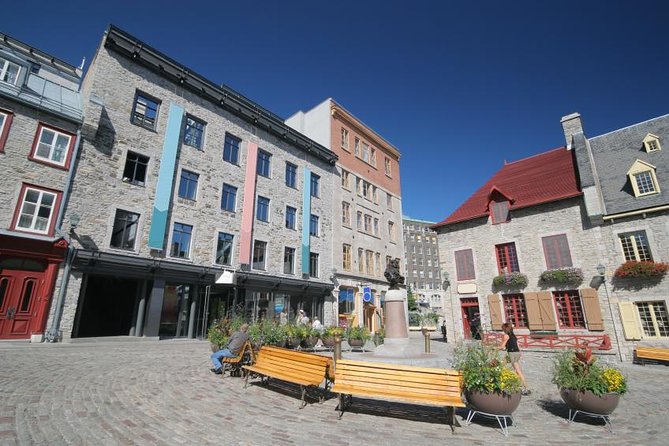
Stop 4 at the ferry crossing area, listed as Trav. Québec-Lévis, serves Place Royale and the lower-town sights. You are near the Louis-Jolliet boat, the interpretation center at Place Royale, Notre-Dame-des-Victoires Church, Maison Chevalier, shops, and restaurants.
This is one of the most useful stops for a first visit. Place Royale is compact, scenic, and packed with historic buildings. The drawback is that this part of town is easy to explore on foot once you arrive, so you may find the bus less useful for short hops within the lower town.
Stop 5 at 306 Rue Saint-Paul brings you to the Old Port promenade and the Old Port Market. This is a good place to leave the bus for food, browsing, and a waterfront walk. It also connects the old city to the riverfront, making it a sensible stop if you want to split your sightseeing between historic streets and the port.
Parliament Hill and the Plains of Abraham
Stop 6 at Place Québec is mainly a useful connection point near the central part of the route. Stop 7 at the Observatoire de la Capitale is more rewarding for sightseeing. It puts you near Parliament Hill, the Parliament Building, the Fontaine de Tourny, and the Promenade des Premiers Ministres.
If you want to visit the observatory, check its separate admission details before counting on the bus ticket to cover it. The hop-on hop-off pass provides transportation and commentary, not admission to the attractions along the route.
Stop 8 at Gén.-de-Montcalm serves the Plains of Abraham, the Plains of Abraham Museum, restaurants, and Parliament Hill. The Plains are one of the city’s best open spaces, and this stop gives you room to stretch your legs after time on the bus.
Stop 9 at the Confucius Monument also reaches the Citadelle, the Plains of Abraham, and Parliament Hill. The overlap with Stop 8 is helpful if one stop is crowded or if you are approaching from a different direction. It also gives you more than one way to plan a visit around the upper city.
The Citadelle appears again at Stop 10, at 1 Avenue du Cap Diamant. This stop is near the Citadelle, the remains of a blockhouse, and the Governors’ Promenade. The location is especially appealing for views because the promenade follows the edge of Cape Diamond.
I would choose one of these upper-city stops based on your priority. Get off at the Parliament Hill area for government buildings and urban sights. Choose a Citadelle or Governors’ Promenade stop for fortifications and dramatic overlooks. The route is good at connecting these places, but you will still do plenty of walking once you leave the bus.
Grande Allée, Cartier, and Saint-Jean-Baptiste
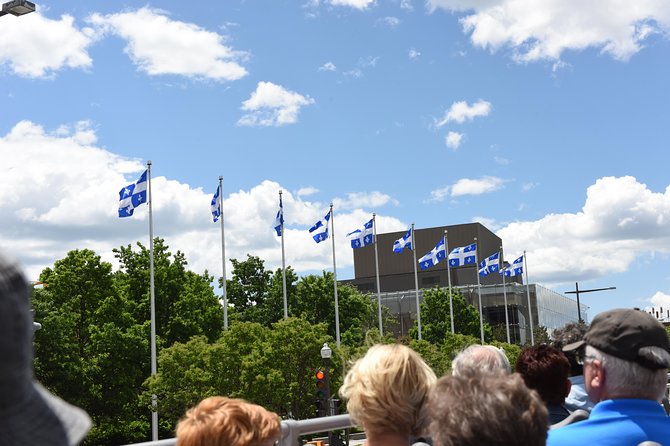
Stop 11 at 290 Grande Allée West serves the Musée national des beaux-arts du Québec and the Plains of Abraham. Art lovers may want to make this a planned stop, while others can use it as another entry point to the park.
Stop 12 at Cinéma Cartier places you near Avenue Cartier, with shops and restaurants. This is less about a single landmark and more about seeing a neighborhood where locals eat, shop, and spend time away from the most concentrated old-town sights.
Stop 13 at 175 Rue Saint-Jean leads to shopping and Saint-Jean-Baptiste Church. Rue Saint-Jean is one of the more useful places to wander after the bus ride, with shops, cafés, and a clear neighborhood identity.
Stop 14 at 931 Rue Saint-Jean is close to Palais Montcalm, Le Capitole, the Faubourg Saint-Jean-Baptiste area, Parc Canada, restaurants, and parking. This is a good stop for combining a meal with a walk through the district.
Stop 15 at the Édifice Thaïs-Lacoste-Frémont returns you toward City Hall. From here, you are again close to the heart of Old Québec and can continue on foot.
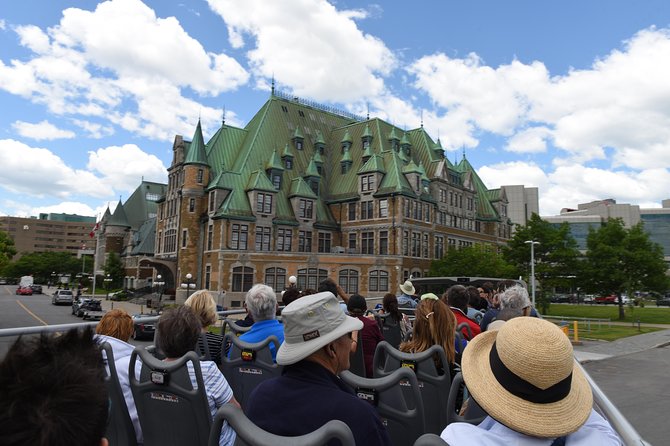
The route’s broad coverage is a real strength. You are not limited to a short circuit around Château Frontenac and Place Royale. You can see the city’s cultural museums, civic buildings, parks, shopping streets, and waterfront districts in one ride.
Same base, a completely different sort of day:
- Half-Day Trip to Montmorency Falls and Ste-Anne-de-Beaupré from Quebec city
★ 4.0 · 2,718 reviews - Old Quebec City: Grand Walking Tour with Private Option
★ 4.8 · 2,609 reviews - Quebec City: Montmorency Falls with Cable Car Ride
★ 4.6 · 2,392 reviews - Quebec City: Montmorency Falls & Ile d’Orleans Half-Day Tour
★ 4.3 · 2,144 reviews
Open-air views, weather, and comfort
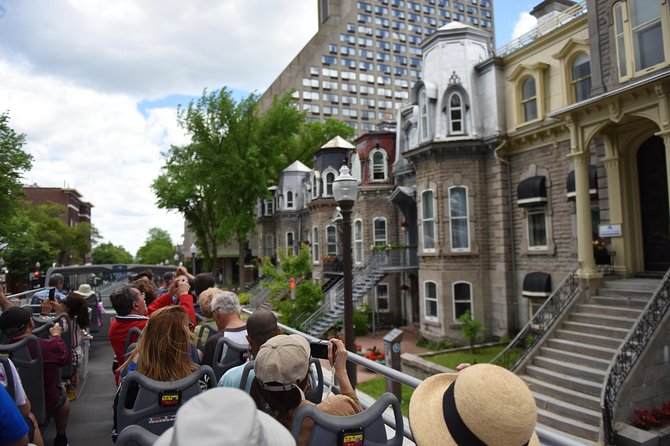
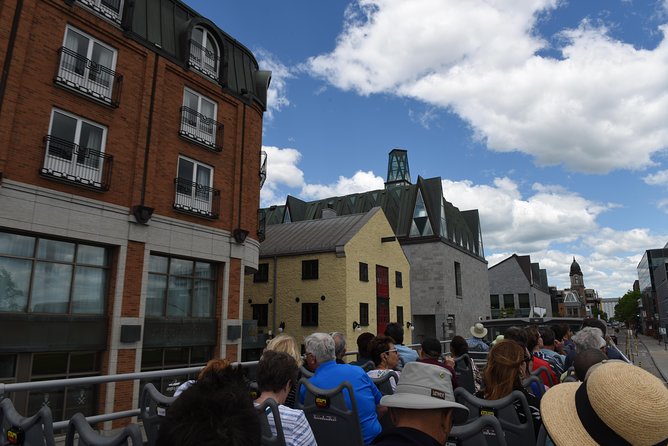
The upper deck is the best seat for sightseeing. You get unobstructed views of streets, buildings, fortifications, and the river-facing parts of the city. It is also the most exposed place on the bus, and a chilly day can make the two-hour ride uncomfortable.
Bring a jacket even if the morning feels mild. The open top is a major part of the appeal, but it is not ideal in cold, wet, or windy weather. The experience requires good weather, and poor weather can lead to a date change or full refund.
The lower deck gives you shelter, but space can be limited. Tall riders may find the legroom tight, and sharing a seat can be awkward for two people who need extra room. The buses are described as clean, and onboard Wi-Fi is included.
The audio system adds useful context without requiring a live guide. You receive earphones and can listen in one of 10 languages. The booking language is English, but the onboard audio offers the wider language choice.
The biggest issue: waiting and reboarding
The central question is not the route. It is how reliably you can board a bus.
On ordinary days, the service can be convenient, with stops in sensible locations and enough coverage to make the pass worthwhile. On high-demand days, especially when several cruise ships are in port or a major festival is taking place, the situation can change quickly.
Buses may arrive full, leaving people at the stop. Waits of 30 to 45 minutes are possible, and some reported waits have lasted 90 minutes or more. In the worst cases, people have waited over two hours before finding space. If you hop off expecting to catch the next bus, you may discover that it has no room.
That makes this a poor choice for a tight itinerary. Do not use it as your only way to reach a timed museum entry, a restaurant reservation, or a cruise departure. Walking or a taxi may be faster when the route is overloaded.
There have also been occasional route changes because of city events, with limited notice at the stops. Ask about current conditions before committing to a long wait, and keep a backup plan for getting back to your hotel or the port.
If you are traveling as a group, sort out ticket handling before boarding. Multiple tickets bought online may be issued through one digital pass, and separate printed tickets may be needed at the information building at Stop 1. Have the ticket ready on your phone, especially before you reach the bus.
Is $46.93 a good value?
At $46.93 per person, the pass is not cheap if you use it for one short ride. The value improves when you complete the full circuit, get off at several distant areas, and use the 2-day option for sightseeing across more than one day.
The price pays for orientation, transportation between scattered districts, the audio tour, Wi-Fi, and the chance to rest between walks. It can be worthwhile if you want a low-effort first look at Quebec City or if you have limited mobility for long stretches of uphill walking, although crowded buses may reduce that benefit.
I would not buy the pass solely as a transportation ticket. The service is designed for sightseeing, and the schedule may not be dependable enough for practical point-to-point travel. Compare the cost with walking, taxis, or public transportation for the particular days you plan to visit.
The 1-day ticket suits a short visit and a complete overview. The 2-day pass makes more sense if you want to divide the city into sections: Old Québec and the Old Port on one day, then Parliament Hill, the Plains, museums, and Saint-Jean-Baptiste on the next.
Who should book this experience?
I would recommend it to a first-time visitor who wants a simple introduction before exploring independently. Families may appreciate the easy overview, and couples can use it to see a lot without planning every street in advance.
It is also useful for a cruise stop when the ship’s timing leaves enough room for delays. For the smoothest experience, avoid the busiest port periods if you can, or wait until later in the morning when the first rush has eased. A later disembarkation has worked better for some cruise passengers than joining the earliest crowd.
You should think twice if you dislike waiting, need guaranteed seating, or have only a few hours in town. In that case, a walking route through Old Québec may give you more control and less time standing at a stop.
My booking advice
Book the Quebec City Hop-On Hop-Off if you want a broad first look at the city, value open-air views, and can keep your schedule flexible. The route is well chosen, the audio usually adds useful background, and the 15 stops reach far more than the postcard center.
Skip it on a day with several cruise ships or a major festival unless the operator confirms that extra buses are running. Even with a 2-day pass, a full bus can leave you stranded at the curb. For most people, the best strategy is to ride the entire loop first, then hop off only where you plan to spend real time.
FAQ
How long does the complete Quebec City bus tour take?
The tour is listed at approximately two hours for the full route. Actual timing can vary because of traffic, route changes, boarding delays, and crowded stops.
How much does the tour cost?
The listed price is $46.93 per person. The exact value depends on whether you choose the 1-day or 2-day pass and how often you use the bus.
Can I choose between a 1-day and 2-day ticket?
Yes. Ticket options include a 1-day pass and a 2-day pass.
What languages are available for the audio tour?
The onboard audio tour is available in 10 languages. The experience itself is offered in English for booking.
Does the tour include hotel pickup?
No. Hotel pickup and drop-off are not included. You board at one of the listed stops.
Is Wi-Fi included on the bus?
Yes. Onboard Wi-Fi is included with the pass.
Where can I board the bus?
You can board at any of the designated stops. Stops include the Fort Museum, the Old Port, the Observatoire de la Capitale, the Plains of Abraham, the Citadelle, Grande Allée, Saint-Jean-Baptiste, and City Hall.
Can I hop off at attractions and reboard later?
Yes. The pass is designed for hopping off at attractions and boarding again when convenient. On very crowded days, however, a later bus may be full.
Is the upper deck open to the weather?
Yes. The open-top upper deck provides broad views but can be chilly or uncomfortable in poor weather. The experience requires good weather.
Can I cancel for a full refund?
Yes, if you cancel at least 24 hours before the experience start time. Changes or cancellations made less than 24 hours in advance are not accepted for a refund. If poor weather cancels the tour, you can receive a different date or a full refund.
Just added around Quebec City
- Stoneham: Nordic spa Thermal Experience★ 4.9 · 20 reviews
- Quebec City’s History in Virtual Reality★ 4.5 · 141 reviews
- Quebec : Old Town Walking Tour With A Local Guide★ 4.5 · 38 reviews
- Quebec: Christmas Interactive Walking Tour of New France★ 4.3 · 7 reviews
- Québec: Fortifications-of-Québec Guided Walking Tour★ 4.7 · 60 reviews
- Quebec Interactive Street Theatre: “Crimes in New France”★ 4.6 · 175 reviews
- Québec City: Weekend River Brunch Cruise★ 4.5 · 116 reviews
- Quebec City: Winter Walking Tour in Old Quebec★ 4.9 · 30 reviews
Quebec City Tours, compared.

Half-Day Trip to Montmorency Falls and Ste-Anne-de-Beaupré from Quebec city
Read our review →
Old Quebec City: Grand Walking Tour with Private Option
Read our review →
Montmorency Falls & Ile d’Orleans Half-Day Tour
Read our review →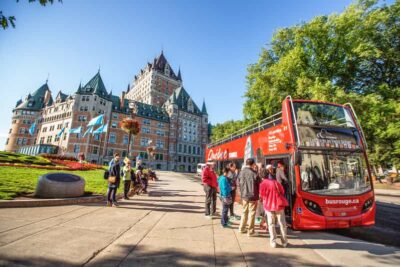
Hop-on Hop-off Open-Top Double Decker Bus Tour
Read our review →Browse the lists this tour appears in