
Review · QUEBEC CITY
Old Québec & French Canada Private History Walking Tour
Quebec City makes more sense when you connect its stones to the wars and people behind them. This private walk ties together Champlain’s 1608 settlement, the French and British fight for North America, the failed American invasion of 1775, and the survival of French culture in Canada. Michel Perron is especially good at linking Quebec and American history with maps, timelines, and old images.
I like the private format, which lets your guide adjust the pace and answer family questions instead of following a fixed script. I also like the clear route through both Upper Town and Lower Town, so you see more than the postcard streets around Château Frontenac. The main caution is physical: this is a walking tour with stairs and historic slopes, so it suits people with a moderate fitness level better than anyone seeking an easy, flat stroll.
Key points to know before you book
- A two-and-a-half-hour history walk: Expect roughly a mile of walking through the main districts of Old Québec, with frequent stops for stories and visual material.
- French, British, and American connections: The tour explains the 1759 battle, the 1763 transfer of Canada to Britain, and the unsuccessful American attack of 1775.
- Private groups up to 10: Your party gets the guide’s attention, and the route can respond to your interests.
- Michel Perron’s visual aids: Maps, timelines, documents, and historical pictures help make complex events easier to follow.
- Upper and Lower Town in one outing: You cover the fortifications, Parliament, Place Royale, Petit-Champlain, the Old Port, and major religious institutions.
- Hotel pickup in Old Québec: If you stay inside Old Québec, the guide meets you in the lobby five minutes before the start.
Why this private walk gives Quebec City a clear storyline
The best feature here is not simply the number of sights. It is the attempt to explain how one small fortified city controlled access to the St. Lawrence River and became the center of French life in North America.
You begin with the military story. A stop at the museum devoted to Canada’s military history sets the stage, from the first French settlers through the 1776 period. That matters because Quebec’s past is not just a sequence of pretty buildings. It is a story of competing empires, strategic waterways, local resistance, and changing governments.
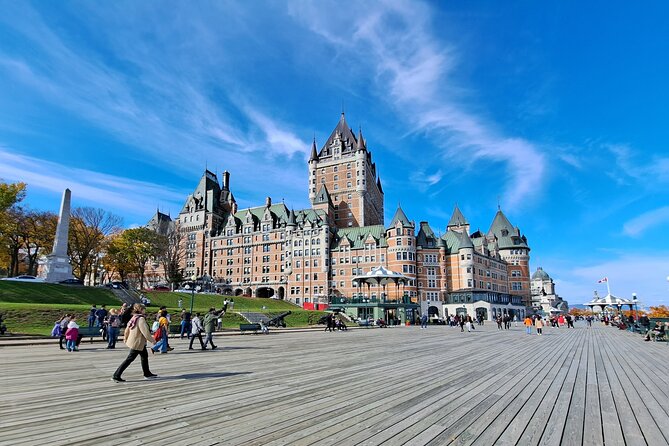
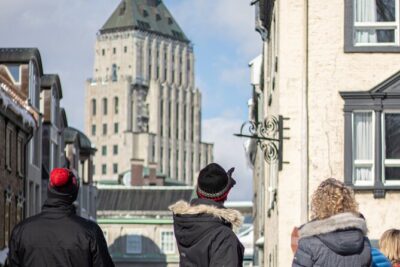
The tour then moves through the city’s symbolic landmarks. You see the 1893 Canadian Pacific Railway Hotel, now the Fairmont Château Frontenac, a building that helped turn Quebec City into an icon of modern Canada. Its grand appearance can seem purely decorative, but the railway hotel also represents the country’s effort to link its regions from coast to coast.
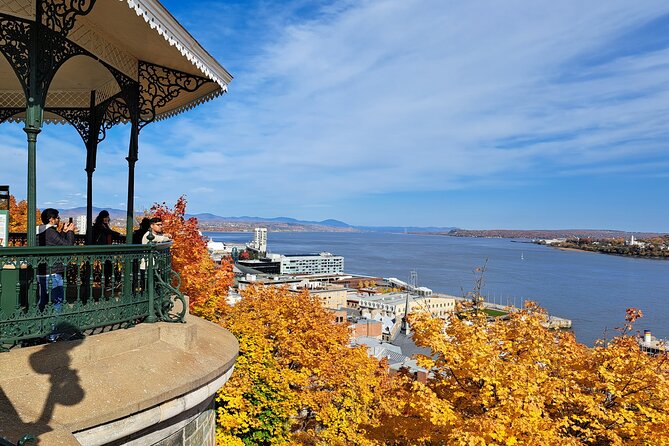
Near the Dufferin Terrace boardwalk, your guide explains the Royal family and its representatives in Canada. Beneath the boardwalk lies the Forts and Châteaux Saint-Louis National Historic Site, the former seat of French governors until the French and Indian War. You cannot understand the terrace fully without knowing what lies below it, and this stop gives the familiar viewpoint a more serious historical layer.
More history-led days in Quebec City:
- Evening Gourmet Tour 5 Course Dinner – History and Food in Old Quebec City
★ 5.0 · 496 reviews - Quebec City: Old Quebec Historical Walking Tour
★ 4.8 · 409 reviews - Combo Historical and Food Tour of Old Quebec
★ 5.0 · 360 reviews
From the Plains of Abraham to the American invasion
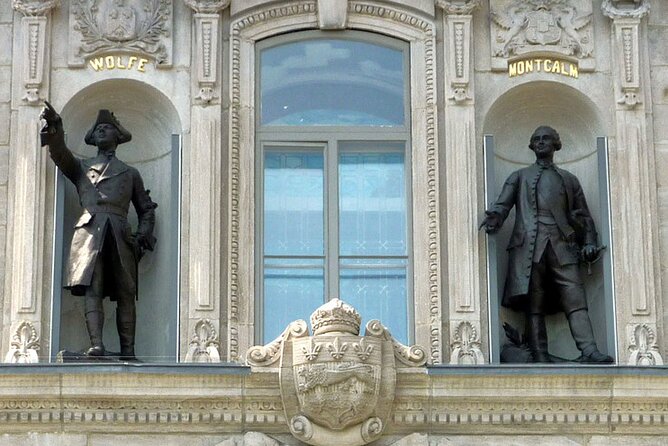
The battlefield portion is the heart of the tour for many history fans. The Plains of Abraham marks the 1759 clash in which British forces defeated the French. That battle helped decide the future of Canada, which passed to Britain under the 1763 Treaty of Paris.
Your guide also points out the war monument connected to the French and Indian War and explains the field in a wider North American setting. The comparison with Yorktown, Virginia, or Chalmette near New Orleans is useful: those places are linked to American victories, while Quebec City is tied to a British victory that changed the political map of the continent.
The American connection continues at the sites of the failed 1775 invasion. Benedict Arnold and Richard Montgomery attacked Quebec during the American Revolutionary War, but both efforts ended in defeat. For visitors from the United States, this is one of the most useful parts of the walk because it presents the campaign from a Canadian perspective rather than treating it as a footnote.
The area connected with the invasion was partly reclaimed from the water over different periods of Quebec’s development. It later became Canada’s old financial district and is now associated with art and antique shops. That mixture of military, commercial, and modern life makes the stop more than a battlefield explanation.
Reading the walls, gates, and cannons of Old Québec
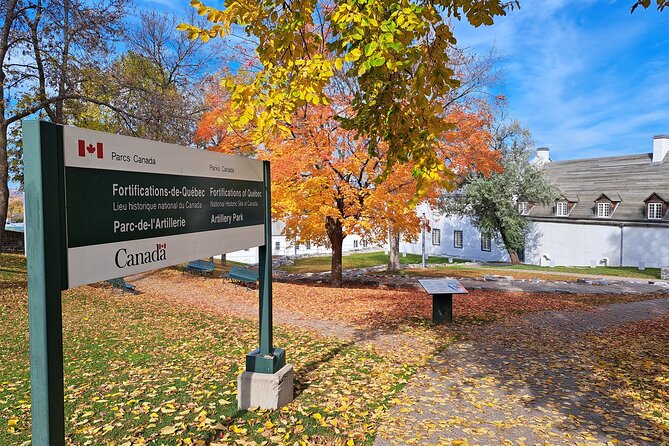
Old Québec’s fortifications are not background scenery. They explain why the city survived as a French and later British stronghold.
The walk follows French and British ramparts built to protect the strategic approach to the St. Lawrence. Quebec’s position allowed its rulers to control the river far into the continent, so the walls had a purpose beyond enclosing a handsome old town.
You also see the stronghold added after the War of 1812, when British authorities feared another American attack. This detail helps explain why Quebec’s defenses continued to grow after the French period had ended. The city was still guarding a major route and still facing a nearby rival.
A cannon platform added during King William’s War offers another piece of the defensive puzzle. In that earlier conflict, Frontenac defeated invaders from Boston led by William Phips. The stop connects local fortifications with wars that stretched across the wider French and English colonies.
The tour includes one of the gates in the French rampart. The original military openings were removed and later rebuilt to resemble medieval structures under Lord Dufferin’s 1875 Quebec Improvement plan. That is a fine reminder that historic cities are often shaped by later ideas about what the past ought to look like. The gate is old in purpose, but its present appearance also reflects nineteenth-century historic taste.
You will also use the stairs linking Petit-Champlain and Upper Town. They are an essential connection between the two parts of the city, but they make the walking route less forgiving. If stairs are difficult for anyone in your group, mention that when arranging the tour and expect the guide to advise you on the route.
Upper Town: Parliament, churches, and French institutions
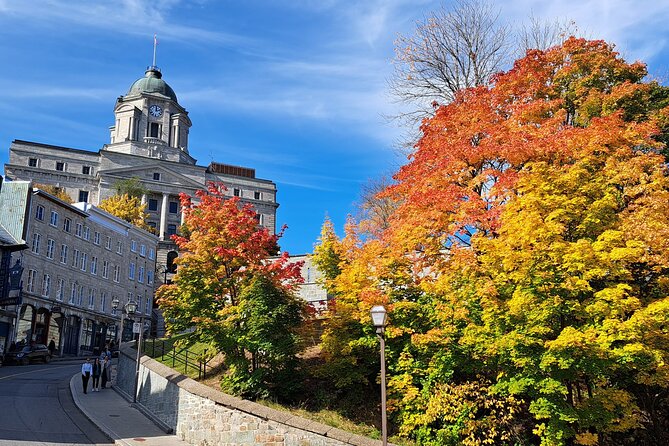
Upper Town mainly covers the UNESCO World Heritage area within the walls. It packs about four centuries of political, military, religious, and architectural history into a compact space.
The Parliament of Québec is an important stop because Quebec City remains the provincial capital even though Montreal is larger and more populous. The building gives your guide a natural way to explain Quebec’s place within Canada and the province’s distinct French-speaking identity.
The religious institutions are especially important. Notre-Dame de Québec is the founding cathedral of Catholicism in French America and the head of a diocese that once reached across a huge portion of the continent, from Quebec City toward New Orleans. That scale is easy to miss when you are looking at one church, so the broader explanation adds real value.
The tour also visits the former school for French Catholic missionaries sent across French territories in North America. The site now includes the School of Architecture of Université Laval and a high school. This stop shows how education and missionary work helped spread French language and Catholic practice far beyond Quebec City.
Two institutions rank among the city’s strongest French heritage sites. The first school for girls in North America is now associated with a museum devoted to French art and Catholic education. The first hospital in North America is now a wellness center and museum. These are not just old facades. They reveal the central role played by women’s religious communities in schooling, health care, and the preservation of French culture.
You should not expect a long museum visit at each location during a 2.5-hour walk. The value is in the explanation of what these places mean and in identifying them for a later, more focused visit.
More walking tours in Quebec City:
- Quebec City Walking Tour
★ 5.0 · 4,716 reviews - Old Quebec City: Grand Walking Tour with Private Option
★ 4.8 · 2,609 reviews - Old Quebec Classique Walking Tour with Funicular
★ 5.0 · 1,317 reviews - Quebec: Crimes of New France Animated Walking Tour
★ 4.6 · 926 reviews
Lower Town, Place Royale, and the city’s beginnings
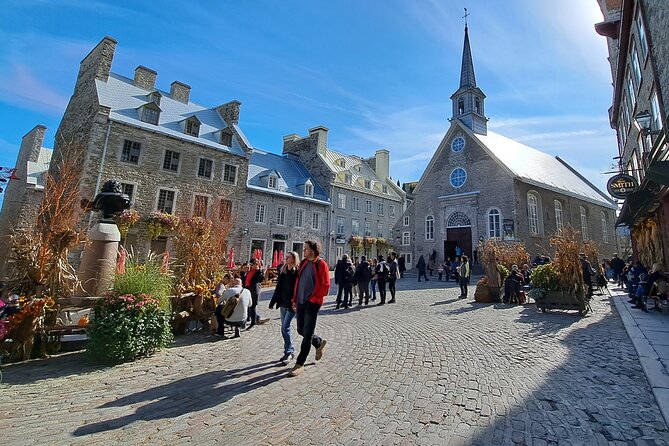
Lower Town includes Place Royale, Petit-Champlain, and the Old Port. It has a high concentration of historic sites, but its atmosphere differs from Upper Town. Here the focus shifts toward trade, settlement, waterfront activity, and the beginnings of the city.
Place Royale is the key stop. In 1608, Samuel de Champlain founded Quebec City here, and the site has been continuously occupied since then. It is the closest thing Quebec City has to a Canadian Jamestown or Williamsburg, although the comparison has limits. The site is both a birthplace of Canada and a reminder that the country’s early story began as a French settlement.
The area also carries a modern planning story. A never-completed museum district project from the 1970s was intended to reshape part of the historic zone. Knowing about that unrealized plan helps you see Old Québec as a living city that has been debated and redesigned, not a preserved stage set.
Petit-Champlain is one of the city’s leading shopping areas. Its current group of high-end artisan shops grew from a 1980s project led by two local architects who wanted to revive a weakened part of the Old Port. I like this stop because it adds a recent chapter to the usual colonial narrative. You see how restoration, local business, and tourism changed the district.
The Old Port is also home to a museum among the city’s top historical institutions, with exhibits on Canada and Native Americans. The itinerary does not suggest an extended museum admission or guided gallery tour, so treat this as an orientation stop and save the full collection for another part of your schedule.
A landmark shaped by the Great Depression
One unusual stop is an imposing monument built in 1929 as the headquarters of a pulp and paper company. It became a symbol of the Great Depression and of the resilience of a Welsh family whose descendants are now involved in high-end tourism in Quebec City.
This detail gives the tour a welcome break from military dates and church history. It shows how Quebec’s identity also grew through industry, immigration, business, and family enterprise. The building’s story is a reminder that the old city did not stop developing after the eighteenth century.
What the guide adds to the walk
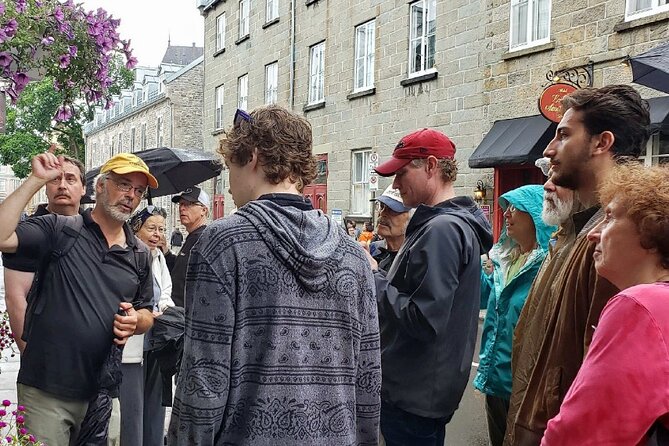
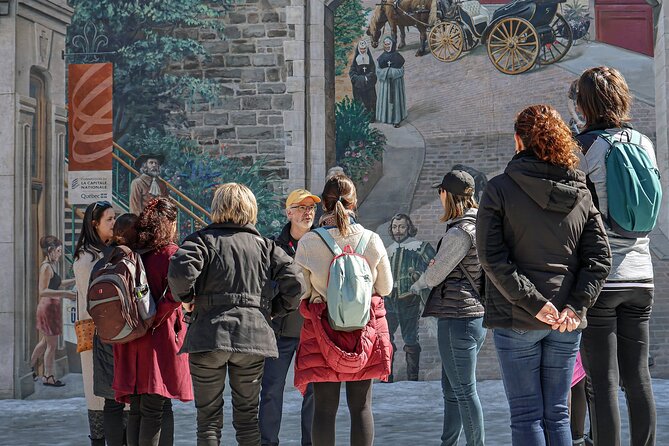
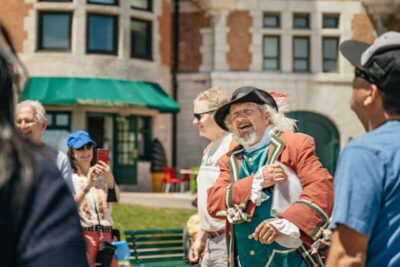
A private guide can make a major difference in a city where several historical periods overlap in the same block. Michel Perron is repeatedly singled out for his ability to explain events in a clear, engaging way, and for tailoring the discussion to the group.
His approach includes maps, timelines, historical photographs, and other material carried in a backpack. That is particularly helpful when the subject turns to the 1759 battle, the Treaty of Paris, or the 1775 invasion. A map can show why the river mattered more quickly than a long speech.
Families should find the format useful. The tour has held the attention of a 7-year-old, a 13-year-old, and adults in the same group, which suggests that the guide can adjust his explanations rather than speaking only to specialists.
You can also bring your own questions. The tour has been adapted around family names and personal interests, and the guide has been praised for responding to questions rather than rushing from one landmark to the next. Another member of the Quebec 1608 team, Richard, is also associated with the experience, so the exact guide may vary.
Price, pace, and practical value
The price is $213.92 per group for up to 10 people. For a solo visitor or a couple, that is a meaningful expense compared with a shared group walk. For a family or group of friends, the per-person price becomes much more reasonable, especially since the cost does not rise with each participant up to the stated limit.
The tour lasts about 2 hours and 30 minutes and includes guiding services. It is offered in English. Pickup is available from hotels in Old Québec, where the guide meets you in the lobby five minutes before the start. If you stay outside the old city, you receive an easy-to-find meeting point instead.
Plan on a moderate level of fitness. The walk covers roughly a mile according to the tour description shared by a past participant, but the distance is not the whole story. Slopes, stairs, standing, and uneven historic surfaces can make the outing feel more demanding than a flat mile.
I would book this near the start of your stay. You will pass many places worth revisiting, including museums, churches, the ramparts, and the shopping streets. The tour gives you a working map of the city so you can return later with more time.
Confirmation comes within 48 hours, subject to availability. Service animals are allowed, and the route is near public transportation. You can cancel for a full refund up to 24 hours before the local start time, but changes or cancellations inside that window are not refunded.
Who should choose this Québec City tour?
I would choose it if you want the city’s major sights explained through the relationship between France, Britain, Canada, and the United States. It is particularly well suited to American visitors curious about the 1775 invasion, families who want a guide who can adjust the level of detail, and first-time visitors who want both Upper and Lower Town in one outing.
History fans will appreciate the military focus, especially the Plains of Abraham, the ramparts, the cannons, and the American attack. Architecture fans will find plenty to notice too, from Château Frontenac and the city gates to churches, schools, hospitals, and the 1929 industrial headquarters.
I would hesitate only if you prefer a slow museum tour, a food-focused walk, or a flat route with little climbing. The experience covers many places, but most stops are viewed and explained from outside or in passing. You will need separate time for full museum visits.
Should you book Old Québec & French Canada Private History Walking Tour?
Book it if you want a strong historical framework, direct access to a guide, and a walk that reaches beyond the most photographed streets. The private setup is the real value for groups, and Michel Perron’s use of maps, timelines, and personal adjustments makes difficult history easier to grasp.
For two people, the price requires a genuine interest in history to feel worthwhile. For a family or group of friends, it is easier to justify. Start your Quebec City visit with this walk, wear comfortable shoes, and leave later time for the museums and interiors that catch your eye.
FAQ
How long does the Old Québec and French Canada tour last?
The tour lasts approximately 2 hours and 30 minutes.
How many people can join the private tour?
The private tour accepts one group of up to 10 people. Only your group participates.
Is the tour offered in English?
Yes. The experience is offered in English.
Is hotel pickup available?
Yes. If your hotel is in Old Québec, the guide meets you in the hotel lobby five minutes before the tour. If your hotel is outside Old Québec, the provider suggests an easy-to-find meeting point.
What level of fitness is needed?
A moderate level of physical fitness is recommended. The route includes walking through Upper and Lower Town, including the stairs linking Petit-Champlain and Upper Town.
Who guides the tour?
Michel Perron is a named guide associated with the experience. Richard is also associated with the tour team, so the specific guide may depend on availability.
Can I cancel for a full refund?
Yes. You can cancel at least 24 hours before the local start time for a full refund. Cancellations or changes made less than 24 hours before the start are not refunded or accepted.
Just added around Quebec City
- 4 Hour Bike Rental in Quebec City with Autoguided Itineraries★ 5.0 · 34 reviews
- 4 Hour Electric Bike Rental in Quebec City with Itineraries★ 5.0 · 41 reviews
- Quebec City : Bike Excursion to Montmorency Falls★ 5.0 · 141 reviews
- Stoneham: Nordic spa Thermal Experience★ 4.9 · 20 reviews
- Quebec City’s History in Virtual Reality★ 4.5 · 141 reviews
- Quebec : Old Town Walking Tour With A Local Guide★ 4.5 · 38 reviews
- Quebec: Christmas Interactive Walking Tour of New France★ 4.3 · 7 reviews
- Québec: Fortifications-of-Québec Guided Walking Tour★ 4.7 · 60 reviews
Quebec City Tours, compared.
Half-Day Trip to Montmorency Falls and Ste-Anne-de-Beaupré from Quebec city
Read our review →
Old Quebec City: Grand Walking Tour with Private Option
Read our review →
Montmorency Falls & Ile d’Orleans Half-Day Tour
Read our review →
Hop-on Hop-off Open-Top Double Decker Bus Tour
Read our review →Browse the lists this tour appears in