

Review · HALIFAX
Halifax Churches, Gardens & Graveyards: a Smartphone Audio Walking Tour
Halifax’s most revealing sights are often quiet ones: a worn cemetery stone, a Victorian fountain, a church touched by the Halifax Explosion, or a statue with an unexpected story. This 5 km GPS audio walk links those details with major sights such as the Public Gardens, Citadel Hill, and the Old Town Clock.
I like two things right away. You control the pace, and the commentary starts as you reach each stop. I also like the price: at $8.98, this gives you a useful introduction to central Halifax for far less than a standard guided excursion.
The main caution is the route itself. It includes hills, uneven paths, and a long string of stops, so it can feel demanding if walking is difficult. The app has also been known to crash or need a restart, though downloading everything on Wi-Fi first should help.
Key points to know before you go

- A 5 km route with 27 narrated stops: Churches, cemeteries, gardens, military sites, statues, and civic landmarks fill the walk.
- GPS-triggered commentary: Your device shows the route and plays narration as you approach points of interest.
- A genuinely flexible schedule: Pause for lunch, stop inside an attraction, or finish another day.
- The best concentration of sights: Halifax Public Gardens, Citadel Hill, the Old Town Clock, Grand Parade, and St. Mary’s Basilica.
- A budget-friendly alternative: At $8.98 per person, the tour costs less than most organized sightseeing options.
- Bring a charged phone and sturdy shoes: Headphones are optional, but the route includes hills and uneven cemetery paths.
What this Halifax audio walk actually gives you
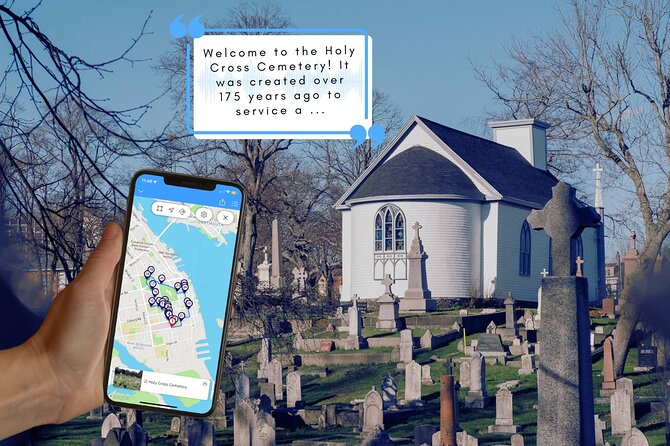
This is not a live tour with a person leading your group. It is a private, self-guided walk from Tripvia Tours, delivered through your smartphone or tablet.
The route begins at 1193 South Park Street and eventually returns to the starting point. It covers about 5 km, with an advertised duration of roughly 90 minutes to two hours. That timing assumes you keep moving and listen at a steady pace. You should allow extra time if you want to wander through the Public Gardens, inspect grave markers, enter a church when open, or pause at the Citadel.
The app uses GPS rather than a fixed meeting time. A live map shows your location and the next point. As you approach a stop, the audio begins automatically. You can also pause or stop anywhere, then resume later.
That makes the walk useful for people who dislike the rigid pace of a group tour. You can take a break when your feet tire, spend longer in a cemetery, or put the walk aside while you visit another attraction. The tour is yours to keep and use at a flexible time, rather than only on the date selected at booking.
Before starting, download the tour over Wi-Fi. No mobile signal or data should be needed during the walk. The commentary plays through your device speaker, though headphones may be more comfortable on busy streets.
More walking tours in Halifax:
- Halifax Harbourfront Small Group Food Walking Tour
★ 4.5 · 63 reviews - Halifax Walking Food Tour
★ 5.0 · 40 reviews - Halifax Boardwalk & Seaport: a Smartphone Audio Walking Tour
★ 4.0 · 19 reviews
South Park Street leads into Halifax’s quieter corners
The opening section around South Park Street and South Street introduces the character of the route. You are not simply marching between headline sights. The walk mixes public monuments, church buildings, cemeteries, gardens, and small historical details that are easy to miss on your own.
The first cemetery stops take you into Holy Cross Cemetery. The narration discusses some of the people buried there and the lost grave of William Condon. This is the kind of material that gives a graveyard more meaning than a quick glance at old stones.
You should expect a quiet, reflective setting rather than a dramatic attraction. Some listeners may find these early stops less immediately exciting than the Citadel or Public Gardens, but they help explain how Halifax remembers its past through small, crowded burial grounds.
Victoria Park connects monuments with greenery

Victoria Park provides one of the more pleasant stretches of the route. The audio points out several features in this urban garden, including the Oland Memorial Fountain and the Cathedral Anglican Church of All Saints across the street.
The church comes with an unusual story involving a mouse problem. That bit of local color gives the narration a lighter touch and keeps the walk from feeling like a list of dates and building names.
You will also hear about the Sir Walter Scott Memorial and the Robert Burns Statue. The Burns stop includes a playful device: Robert Burns himself provides part of the explanation. It is a small theatrical touch, but it helps break up the more formal historical commentary.
Victoria Park is a good place to slow down. If you are taking photographs or simply want a bench, this section gives you room to do that without losing the main thread of the tour.
Halifax Public Gardens shows the city’s Victorian side

The Halifax Public Gardens is one of the strongest portions of the walk. The formal garden is a designated National Historic Site, and its layout reflects Victorian taste, with carefully arranged plantings, paths, water features, and ornamental details.
The audio explains the garden’s design and introduces Richard Power, an Irish horticulturist and landscape gardener who was given responsibility for creating the grounds. That context helps you read the garden as a planned civic space, not just a patch of flowers in the middle of the city.
Several stops spread through the gardens. You will hear about the Horticultural Hall, the oldest building in the park, which was also used as a cold cellar. The nearby bandstand is about 130 years old, adding another layer to the park’s social life.
Griffin’s Pond offers a quieter pause. Ducks and geese may be present, and the narration explains how the pond relates to what was once swampy ground. The route then reaches the Boer War Memorial Fountain, erected in 1903 for Canadian soldiers who fought and died in the conflict, followed by the Victoria Jubilee Fountain, built to mark Queen Victoria’s 60th year as monarch.
The gardens are one place where the self-guided format works especially well. You can listen, look closely, and then stop the audio while you enjoy the setting. Check access conditions before you go, since recommended attractions can be closed or inaccessible depending on the season or other circumstances.
More self-guided routes in Halifax:
- Explore Halifax with 3 Unique Smartphone Audio Walking Tours
★ 4.0 · 16 reviews - Private Self-guided River Rafting Tour in Calgary
★ 5.0 · 182 reviews - Mont-Tremblant: Treetop Observatory and Self-Guided Walk
★ 4.7 · 130 reviews - Icefields Parkway: a Smartphone Audio Driving Tour
★ 4.0 · 118 reviews
Camp Hill and the Commons widen the story

After the Public Gardens, the walk turns toward the Protestant Camp Hill Cemetery. You learn why the cemetery was created on the old Commons ground and why its older stones are worth browsing.
This is another section where sturdy shoes matter. Cemetery paths may be uneven, and the route is not a flat stroll from start to finish. If you prefer a short, easy walk, you may find this portion tiring.
The Nova Scotia Museum of Natural History is also pointed out. The tour describes it as an unassuming modern brick building outside, with unusual displays inside. The experience does not include admission, so you will need to pay separately if you decide to enter.
The route then explains the South Commons and North Commons. South Commons has been used by Halifax for more than 250 years and is described as Canada’s oldest urban park. The narration also clarifies why the word Commons appears repeatedly in Halifax’s story.
These stops are useful for understanding the city’s public spaces, but they may feel less dramatic than the formal gardens or military landmarks. One earlier walk found the Commons historically interesting but visually ordinary. That is a fair expectation: the value here is mainly in the explanation.
The Halifax Armoury and Citadel Hill bring the military story forward

Armoury Place introduces the large Halifax Armoury, built in 1895 as a drill hall for volunteer militia. The audio also explains how the building is used today.
From there, the route reaches Halifax Citadel National Historic Site. Citadel Hill is the highest point in Halifax, and its position explains why it was selected for a fort. The narration covers whom the fort was intended to protect the city from and gives you a basic framework for understanding Halifax as a military and naval center.
The walk appears to point out the Citadel rather than include admission. If you want to tour the fort’s interior, see demonstrations, or explore its exhibits, plan that as a separate visit and allow more time.
This is one of the places where you will want to pause the audio and look around. The Citadel is not something to rush past, especially if you are interested in fortifications or Halifax’s role in British North America. The route itself can guide your orientation, but it cannot replace time inside the site.
The Old Town Clock follows naturally. Prince Edward, Commander in Chief of the military, commissioned the clock, and the narration explains why. The clock is one of Halifax’s familiar symbols, but hearing the reason behind its construction makes the stop more than a photo opportunity.
Grand Parade and City Hall anchor downtown Halifax

Grand Parade remains the civic heart of Halifax, and the audio explains how it came to be built. The area also includes the Halifax War Memorial Cenotaph, giving the stop a direct connection to public remembrance.
Next comes Halifax City Hall, a National Historic Site of Canada designated in 1997. The tour also points out the Memorial to Fallen Peace Officers. These stops shift the focus from military defense and burial grounds to city government and civic memory.
The advantage of an audio guide here is simple: you can stand in the square and know what you are looking at without juggling a guidebook. The drawback is that city spaces can be noisy, so headphones may help if you want to hear every word.
Four churches and the Old Burying Ground close the loop

St. Paul’s Anglican Church is among the oldest church-related stops on the route. The narration covers the building’s age, long history, and connection to slavery. That subject deserves attention because it places Halifax’s religious and civic development within a wider Atlantic story rather than presenting the church as only an attractive old building.
St. Mary’s Cathedral Basilica brings another major architectural point. It is a Gothic Revival cathedral, and the audio connects it to the Halifax Explosion of 1917. The effects of that disaster can still be seen in the city, and this stop gives you a reason to look closely at the building rather than simply walk by.
The Old Burying Ground is a small cemetery occupying about one hectare. You will hear how old it is and why this small piece of land matters. Take time here if you enjoy inscriptions and personal memorials. The stones offer a more intimate connection to earlier Halifax than a broad city viewpoint can provide.
The final listed stop is Fort Massey Cemetery. The story reaches back to the American Revolutionary War in 1775 and explains why Britain considered Halifax an important naval base. It is a fitting endpoint for a walk that has linked churches and graveyards with military planning, public gardens, and civic spaces.
How the technology works in real use
The strongest feature is the automatic playback. When the GPS recognizes that you have reached a point, the narration begins. That means you do not need to keep checking a list of street names or guess which building the text is describing.
The map also helps you keep your bearings. The route covers many blocks and several different types of public space, so having your position and next stop visible is useful.
You should still give the app a moment to work. One user found the navigation a little tricky at first, and another experienced repeated crashes. These problems do not make the tour unusable, but they are a reason to download the content before leaving, keep your phone charged, and know that you may need to reopen the app.
The location-based trivia game is optional. After a piece of commentary plays, you can answer a question on your device. I see this as a nice extra for families or anyone who enjoys a bit of structure, but you can ignore it and focus on the buildings, gardens, and stones.
Is $8.98 good value?
Yes, if you want orientation and historical context at a low cost. The tour costs $8.98 per person and includes the audio, GPS map, automatic narration, flexible use, and customer service by phone and email.
The value is especially clear if you compare it with a pricey organized excursion. You get a private experience for your own group, without waiting for other people or keeping up with a guide. The tradeoff is that nobody is physically present to answer a question, adjust the route, or explain something unexpected.
At this price, I would treat the tour as a strong introduction rather than a complete Halifax sightseeing plan. Use it to learn the city’s layout, then spend extra time at the Public Gardens, Citadel, churches, or museum that interests you most.
Who should choose this walk?
This experience suits you if you like setting your own pace, prefer independent sightseeing, or want a low-cost introduction before choosing which attractions deserve admission fees. It also works well for solo visitors, couples, friends, and families who do not want to join a crowded group.
It is less suitable if you want a live guide, a very short route, or a fully accessible flat walk. Hills and uneven cemetery paths are part of the experience, and most of the recommended attractions are only viewed from the route unless you pay to enter separately.
The tour is offered in English. Service animals are allowed, it is near public transportation, and most people can participate. Attractions may be closed because of the season or other conditions, so treat the audio as a route through the city rather than a guarantee that every door will be open.
Should you book the Halifax Churches, Gardens & Graveyards walk?
Book it if you want flexible sightseeing with real historical detail and do not mind managing your own phone. The Public Gardens, Citadel, Old Town Clock, Grand Parade, St. Mary’s Basilica, and Old Burying Ground give the walk plenty of worthwhile anchors.
I would skip it if your main goal is a polished live performance or if 5 km of walking sounds like too much. For everyone else, $8.98 is a sensible way to get your bearings, hear stories you might miss in a guidebook, and explore Halifax without surrendering your schedule.
FAQ
How long is the Halifax audio walking tour?
The tour takes approximately 1 hour 30 minutes to 2 hours and covers about 5 km. You can take longer because the audio tour can be paused or stopped.
How much does the tour cost?
The listed price is $8.98 per person.
Where does the tour begin and end?
It begins at 1193 South Park Street in Halifax, Nova Scotia, and ends back at the same meeting point.
Is the tour guided in person?
No. It is a self-guided smartphone audio tour. GPS triggers the commentary as you approach each point of interest.
Do I need mobile data during the walk?
No. You should download the tour over Wi-Fi before starting. After that, no signal or mobile data is required during the tour.
Can I pause and restart the tour?
Yes. You can begin, pause, stop, and restart the tour at your own pace. The tour is yours to use at a flexible time.
Are attraction admission tickets included?
No. Admission tickets are not included. The tour points out attractions and provides commentary, but entry fees are separate.
What happens if I need to cancel?
You can receive a full refund if you cancel at least 24 hours before the experience start time. Cancellations or changes made within 24 hours are not refunded or accepted.
More Audio Tours in Halifax
- Cabot Trail: a Smartphone Audio Driving Tour
★ 4.5 · 118 reviews - Niagara: Behind The Falls, Skylon Tower Ticket & Tesla Audio Tour
★ 3.5 · 69 reviews - A 7th-Gen Local’s View of Downtown Charlottetown: An Audio Tour
★ 4.5 · 27 reviews - Smartphone Audio Driving Tour between Banff and Calgary
★ 4.0 · 25 reviews
Just added around Halifax
- Mersey River Quickie Adventure – 2 Hours★ 5.0 · 142 reviews
- Southern Lakes Canoe Trip – 4 Day★ 5.0 · 23 reviews
- Zodiac Coastal Tour with Naturalist Guide: Lunenburg★ 5.0 · 105 reviews
- Private Tour in Halifax by a Luxury Vehicle with Informative Guide★ 5.0 · 92 reviews
- Winter Wine Escape★ 5.0 · 8 reviews
- Wine Tour Wolfville Wine Tours in Nova Scotia- 6 Hours★ 5.0 · 14 reviews
- Wine Enthusiast Tour Lead by a Sommelier★ 4.5 · 6 reviews
- JFarwell Sunset Wine and Cheese Yacht Sailing★ 5.0 · 149 reviews
Halifax Tours, compared.






Halifax Premium Tour: Peggy’s Cove, Citadel & Titanic Cemetery
Read our review →
Tall Ship Silva Sailing Cruise Ft. a Live Musician
Read our review →
Browse the lists this tour appears in