
Review · CANMORE
The Sights of Canmore: a Smartphone Audio Walking Tour
Canmore’s story comes into focus through its coal-mining landmarks, mountain views, and quirky public art. This self-guided walk leads you from Railway Avenue through the town center, along Policeman’s Creek, past old civic buildings, and finally to the Big Head Sculpture, where you learn how Canmore got its name.
I like the freedom to start and stop whenever you wish, and I like the mix of serious local history with lighter stops such as bear sculptures, an inukshuk, and a red telephone box. The main drawback is that this is an app, not a person: you need your own charged smartphone or tablet, and you must download the tour on Wi-Fi before setting out.
Key points to know before you walk
- Coal-mining history: Hear how mining, the railway, labor disputes, and the Miners’ Union Hall shaped Canmore.
- A 5 km return route: Allow about 1.5 to 2 hours for the full walk, with extra time for photos, shops, and stops.
- Automatic GPS narration: Commentary plays as you approach each point of interest, so you can keep your eyes on town and mountains.
- A playful trivia option: Answer location-based questions after the audio at each stop, or skip the game and simply listen.
- Flexible timing: The tour can be used beyond your booking date and paused whenever you want.
- Low price, limited extras: At $8.22 per person, it is inexpensive, but attraction admission, a device, and human guidance are not included.
Starting near Railway Avenue and Three Sisters Gallery

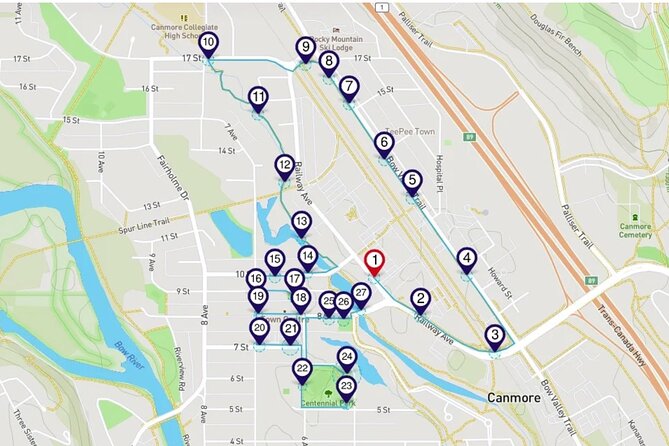
The walk begins at 909A Railway Avenue, close to Three Sisters Gallery. You do not meet a guide here. Instead, open the tour on your phone and follow the live GPS map, which shows your position and the next point on the route.
The opening section sets up Canmore as more than a pretty Rocky Mountain base. You will hear about notable sights, sculptures, and buildings linked to the town’s coal-mining days. This matters because Canmore’s modern identity can easily overshadow its industrial past. The audio gives you a reason to look twice at ordinary streets and structures.
The route covers about 5 kilometers in total, returning to the starting area. The stated walking time is 1 hour 30 minutes to 2 hours, though your actual pace will depend on how long you spend at the boardwalk, parks, museum area, shops, and photo stops.
More walking tours in Canmore:
- Canmore: Stargazing and Nature by Nightfall Walking Tour – 2hr
★ 5.0 · 31 reviews - Canmore: Wilderness & Wildlife Tour – 2hr Walk
★ 5.0 · 29 reviews - Canmore Town Walking Tour with Refreshment and Sweet Treat
★ 5.0 · 27 reviews
Railway tracks, telephone boxes, and bear sculptures
At Bow Valley Trail and Railway Avenue, the audio turns to the Canadian Pacific Railway. The tracks are not just something to cross on the way downtown. They help explain how transportation affected Canmore’s growth and connected the mining town to a much wider network.
Next, at Sidney Street and Bow Valley Trail, you will see a British red telephone box. The stop uses a familiar object to add a small piece of cultural history to the walk. It is the kind of detail an ordinary stroll might miss, especially when your attention is pulled toward the mountains.
The next two stops feature black bear and grizzly bear sculptures. The narration explains differences between the animals and offers basic context about black bears in Canmore and the Rocky Mountains. These are lighter stops than the railway or mining sections, but they help break up the historical material.
The bear sculptures also show the tour’s general approach. It does not focus only on monuments or formal museums. It uses public art and street details as entry points into local stories. That keeps the walk varied, though anyone wanting a serious wildlife talk should treat these as short introductions rather than a full nature program.
Mountain names, an inukshuk, and the coal cars

At Bow Valley Trail and 15 Street, you get a northern mountain view and hear the stories behind several peaks, including Princess Margaret Mountain, Mount Charles Stewart, Mount Lady MacDonald, and Mount Grotto. The information about Squaw’s Tit is also included in this section, though names and terminology can change over time. The stop is useful because it encourages you to connect the view with the names on a map.
At 17 Street, a large inukshuk provides another brief cultural stop. The audio explains what inukshuks are, giving context to a form that many people recognize but may not fully understand.
The coal-mining cars monument at Railway Avenue and Bow Valley Trail is one of the most important stops on the route. Here, the focus returns to the industry that helped build early Canmore. The mining cars make the subject visible and concrete. Instead of hearing only dates and names, you are looking at an object tied to the work itself.
I would pay close attention here if you want the clearest sense of Canmore before its current tourism economy. The walk later returns to labor and civic history, but the mining cars give you an early anchor.
Policeman’s Creek Boardwalk and the Bow River
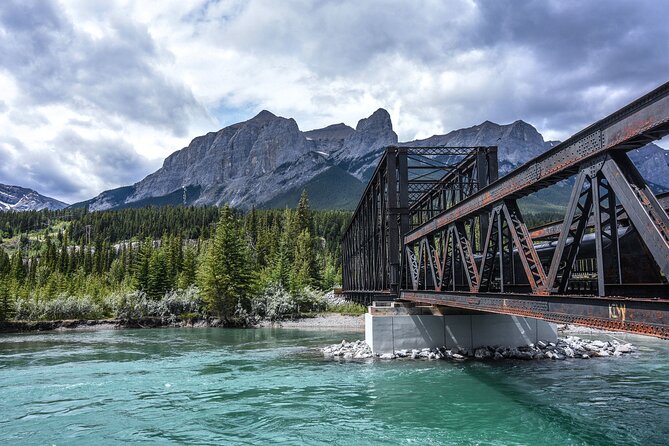
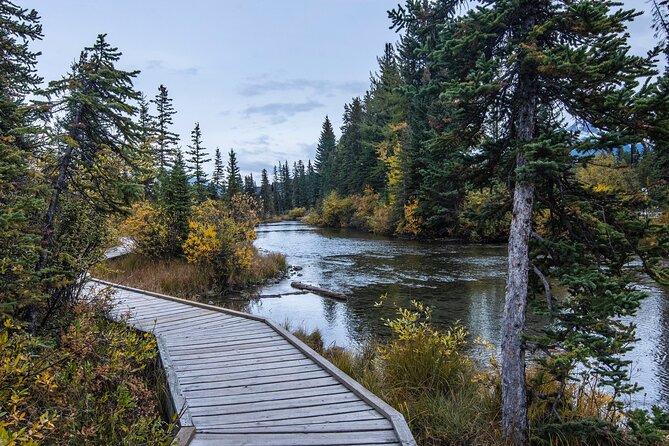
The Policeman’s Creek Boardwalk is one of the longer sections, with about 10 minutes of audio and sightseeing. You will walk along part of the boardwalk while hearing about the Bow River, the Canmore Nordic Centre, festivals, and local events.
This is one of the tour’s strongest pairings of scenery and information. You are not simply looking at a pretty creek. The narration connects the natural setting with recreation and community life. The Canmore Nordic Centre also points to the town’s role as an outdoor destination, while the festival material shows how public spaces are used beyond the normal sightseeing season.
The boardwalk is a place to slow down. The app lets you pause, so you can take photographs or enjoy the surroundings without losing your place. Keep in mind that automatic audio depends on the GPS connection and your device, so it is wise to watch the map occasionally rather than assume every prompt will happen at exactly the right moment.
More self-guided routes in Canmore:
- Private Self-guided River Rafting Tour in Calgary
★ 5.0 · 182 reviews - Mont-Tremblant: Treetop Observatory and Self-Guided Walk
★ 4.7 · 130 reviews - Icefields Parkway: a Smartphone Audio Driving Tour
★ 4.0 · 118 reviews - Cabot Trail: a Smartphone Audio Driving Tour
★ 4.5 · 118 reviews
Mount Rundle, Isabelle Dube, and the Canmore Museum

At 10 Street and 6 Avenue, the audio focuses on Mount Rundle. This is a useful mountain-view stop because it shifts your attention from a broad northern panorama to one prominent peak. You will hear what the tour knows about the mountain while standing in an urban part of Canmore.
At 719 10 Street, the route points out a mural of Isabelle Dube and explains the tragic story connected with it. This is a more somber moment. It gives the town’s public art a human story and adds emotional weight to a walk that otherwise moves between mining facts, sculptures, and scenery.
The Canmore Museum and Geoscience Centre comes next. The museum has more than 10,000 artifacts and has welcomed visitors since 1984. The audio helps you understand why the building matters, but admission is not included, so you will need to decide if you want to enter separately.
That arrangement is fair for a low-cost walking tour. You pay for the route and narration, not for entry to every attraction. Still, budget extra time and money if the museum is a priority, and check its current access before relying on a visit.
Friendship Park and Main Street
Friendship Park provides a short stop with an international connection. You will learn what Canmore shares with Higashikawa, a Japanese city. The stop adds a little variety after the museum and gives you a quiet place to consider the town beyond its Canadian mining and mountain identity.
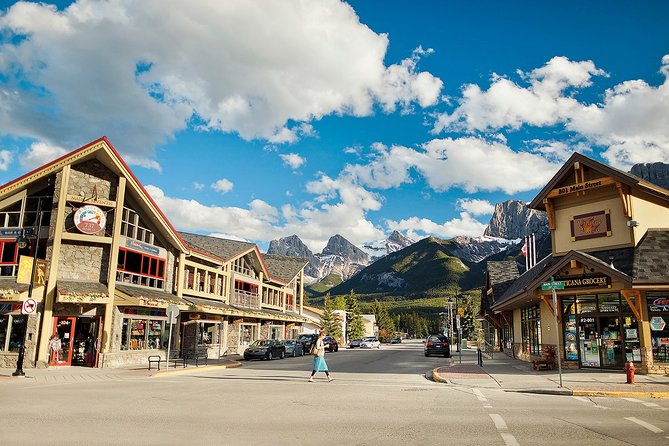
The route then moves along Main Street near 8 Avenue and 6 Street. Shops, restaurants, and galleries become part of the tour here. This is a good place to pause the audio and browse if something catches your eye. The flexible format works better than a fixed group walk in this part of town, since you can stop without holding anyone up.
The tradeoff is that the route’s timing becomes less predictable. If you shop, eat, or enter a gallery, the original 1.5 to 2 hour estimate no longer tells the whole story. That is not a problem, but it helps to think of the time as a guide rather than a deadline.
Canmore Inn and Suites and the Miners’ Union Hall
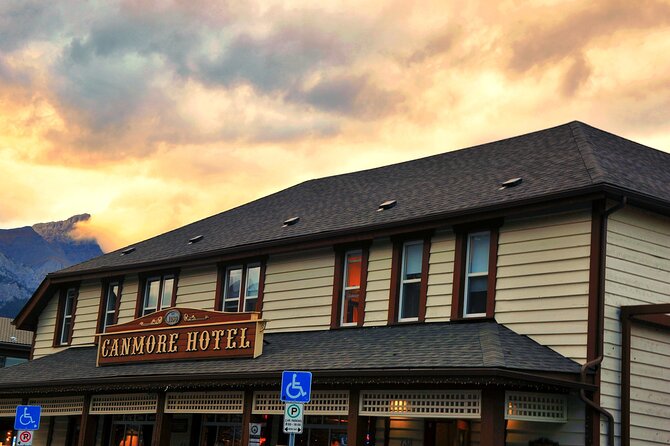
The Canmore Inn & Suites is linked to a building constructed in 1890 by Count Eugene de Rambouville. The audio treats it as one of the town’s older landmarks, giving you another chance to spot history amid modern businesses and accommodations.
The Canmore Miners’ Union Hall is a more substantial historical stop. You will learn about one of the town’s important cultural buildings and the often contentious relationship between Canmore and its miners. This is where the earlier coal cars and railway material gain more meaning.
The union hall is especially valuable for anyone interested in working history. Many town walks celebrate founders, scenic views, and grand buildings while skipping labor. This route gives miners a clear place in Canmore’s story, including the tension that came with mining work and organized labor.
The narration at each regular point is short, generally about three minutes. That keeps the pace moving, but it also means the tour offers a series of focused snapshots rather than a long lecture at each site.
Centennial Park and Ralph Connor Memorial United Church
Centennial Park includes three subjects: views of the Three Sisters Mountains, the Stan Rogers stage, and annual festivals and events held in the park. It is another stop where the audio links scenery with daily community life.
The Three Sisters view supplies one of the walk’s best photo opportunities. The Stan Rogers stage and event information show how the park functions as a gathering place, not merely a patch of grass along the route.
At Ralph Connor Memorial United Church, you will see one of Alberta’s earliest Presbyterian churches and hear the mystery behind its name. This stop adds religious and architectural history to a tour that has already covered mining, railways, public art, and parks.
The church is a reminder that Canmore’s early story was built from several institutions, not just the mine. The narration is brief, so look carefully at the building while the audio plays.
NWMP Barracks and the Big Head Sculpture
The NWMP Barracks is described as one of Canmore’s important attractions. The audio explains how the barracks helped maintain law and order during the town’s rougher early years.
This stop rounds out the historical arc. You have already heard about the railway, mining, workers, and civic buildings. The barracks adds the official side of town life, showing how order was maintained while Canmore developed.
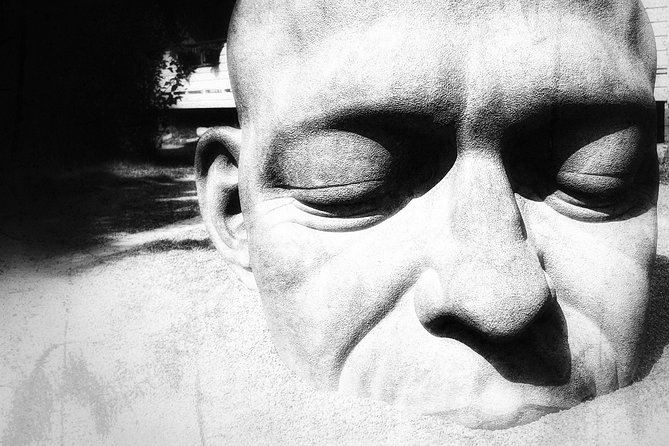
The final point is the Big Head Sculpture. The audio explains the unusual sculpture and its connection to the name Canmore itself. Ending here gives the tour a memorable finish. After serious material about mining and law enforcement, the odd sculpture brings the walk back to Canmore’s more playful public character.
Because the tour returns to the starting point, you are not left trying to arrange transport from a distant endpoint. You can also use the app again later, since the tour is yours to keep and is not limited to the original booking date.
How the app works in practice
Download the tour over Wi-Fi before you start. Once it is on your device, no mobile signal or data use is required during the walk. That is a real advantage in a mountain setting, where reception may not be dependable.
The live GPS map shows where you are and where to go next. As you approach a point of interest, the guide commentary is designed to play automatically. After the audio, an optional trivia question appears, and you tap your answer on the device.
The game is a nice extra for families and anyone who likes a little structure. You can ignore it if you prefer to walk quietly. The audio also lets you stop and restart anywhere, which is useful if you want lunch, enter the museum, browse Main Street, or spend extra time at the boardwalk.
The number of people selected at booking determines how many devices can download the tour. A smartphone or tablet is not supplied, and the experience is offered in English only. Service animals are allowed, and the activity is near public transportation. Most people can take part, but you should still consider the 5 km distance and your comfort with walking.
Is $8.22 a fair price?
At $8.22 per person, this is a strong value if you want orientation, local stories, and a structured route without paying for a private guide. A human-led walking tour would normally offer conversation and the chance to ask questions, but this format removes group size, fixed departure times, and guide tipping.
You are paying for convenience rather than personal attention. The commentary is prerecorded, and the tour does not include museum admission or other attraction tickets. If your main goal is a fast, scenic walk with a few facts, you may use only part of the material. If you want to understand Canmore’s mining past and see a wide range of landmarks, the low price makes the audio useful.
Cancellation is available up to 24 hours before the experience for a full refund. Confirmation arrives at booking, and the tour is available daily from midnight to 11:30 p.m. during the stated operating period, which makes it easy to fit around other plans.
Who should book this Canmore walk?
I would choose this tour if you like exploring independently but do not want to research every stop yourself. It suits couples, families, and small private groups who want to move at their own pace.
It is also a good first activity in Canmore. The route introduces the railway, coal mining, public art, parks, churches, the museum, and major mountain views. Afterward, you can decide which subjects deserve more time.
You may want something else if you need a live guide, detailed question-and-answer time, or a tour focused mainly on hiking and nature. This is an urban walking route with historical and cultural commentary, not a wilderness excursion.
FAQ
Where does the tour start and finish?
It starts at 909A Railway Avenue in Canmore, Alberta, and ends back at the meeting point.
How long is the walking route?
The route is about 5 kilometers round trip. The estimated time is 1 hour 30 minutes to 2 hours, not counting longer stops for shopping, meals, photographs, or museum visits.
Do I need mobile data during the tour?
No. You should download the tour over Wi-Fi before starting. After that, no signal or mobile data is required during the walk.
Does a guide accompany the group?
No. This is a smartphone audio tour with GPS-triggered commentary. Your group participates privately and follows the route independently.
Is the trivia game required?
No. The location-based trivia questions are optional. After the commentary plays, you can tap an answer or simply continue walking.
Are attraction admissions included?
No. Attraction tickets are not included. The Canmore Museum and Geoscience Centre is one of the places highlighted, but entry is separate.
Can I take the tour on a different date?
Yes. The tour is flexible and can be used anytime through Tripvia Tours after download. You can also pause and restart it anywhere along the route.
Should you book it?
Book this Canmore audio walk if you want a cheap, flexible introduction to the town with more substance than a simple stroll. The coal cars, Miners’ Union Hall, NWMP Barracks, Policeman’s Creek Boardwalk, and Big Head Sculpture give the route a good range of subjects, while the GPS narration and trivia keep you moving.
Skip it if you strongly prefer a live storyteller or if your Canmore plans leave no room for a 5 km walk. For everyone else, $8.22 buys a useful town orientation, a bit of humor, and a clearer sense of how mining, railways, public spaces, and mountain views shaped Canmore.
More Audio Tours in Canmore
- Niagara: Behind The Falls, Skylon Tower Ticket & Tesla Audio Tour
★ 3.5 · 69 reviews - A 7th-Gen Local’s View of Downtown Charlottetown: An Audio Tour
★ 4.5 · 27 reviews - Halifax Churches, Gardens & Graveyards: a Smartphone Audio Walking Tour
★ 4.5 · 25 reviews - Smartphone Audio Driving Tour between Banff and Calgary
★ 4.0 · 25 reviews
Just added around Canmore
- Yoho National Park: Emerald Lake and Takakkaw Falls★ 5.0 · 4 reviews
- Rocky mountain – VIP Experience – Private Boat★ 5.0 · 6 reviews
- Sunset at Moraine Lake & Stargazing Tour from Canmore/Banff★ 5.0 · 95 reviews
- 2 Day Banff Lake Louise Johnston Canyon Gondola Cave Basin tour★ 4.5 · 8 reviews
- Banff/Canmore Moraine Lake & Lake Louise– Hike, Canoe or Sightsee★ 5.0 · 104 reviews
- Experience Golden Hour at Moraine and Lake Louise★ 5.0 · 18 reviews
- Private Tour: Majestic Mountains PHOTO SAFARI Drive – 4H★ 5.0 · 4 reviews
- Canyons and caves in the Rockies: Explore with us; From Calgary★ 5.0 · 27 reviews
Canmore Tours, compared.


Moraine Lake & Louise – Morning or Sunset Tour from Banff/Canmore
Read our review →
Moraine Lake Sunrise(2.5hrs)&Lake Louise(2hrs) from Canmore/Banff
Read our review →
From Canmore/Banff: Moraine Lake Sunrise & Lake Louise Tour
Read our review →
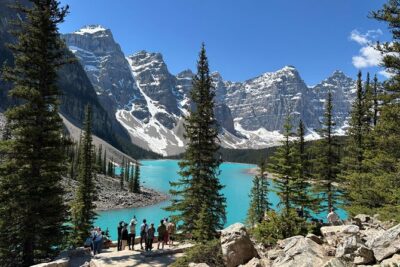
Moraine Lake & Louise & Banff Day Tour From Calgary-Canmore-Banff
Read our review →Browse the lists this tour appears in