
Review · BANFF
The Sights of Banff: a Smartphone Audio Walking Tour
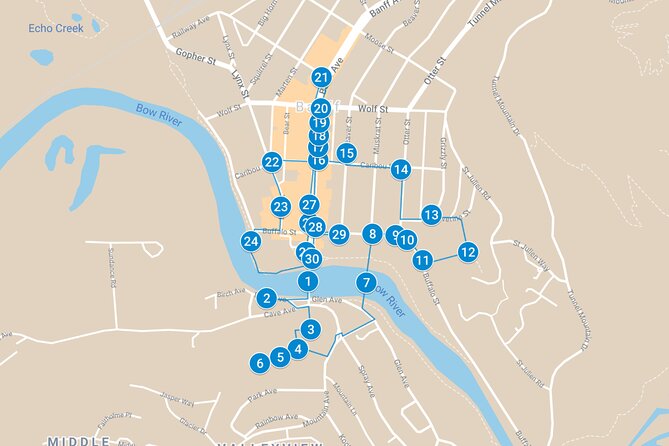
Banff’s story unfolds best on foot, and this inexpensive audio tour gives you a useful introduction without tying you to a group or a clock. Over roughly 5 km round trip, you’ll pass old cabins, park buildings, gardens, sculptures, churches, and Bow River views while commentary plays from your phone.
I like the flexible timing, since you can start whenever you wish and keep the tour for another day. I also like the offline GPS setup, which saves mobile data and lets you walk without relying on a signal. The main caution is the app: some people found its map and directions confusing, and one version reportedly jumped away from the map.
Key points to know before you walk

- Twenty-seven named stops cover Banff’s buildings, public art, gardens, museums, and early town history.
- GPS-triggered audio plays as you approach each point, with no live guide or fixed departure time.
- Offline use means you can download the tour on Wi-Fi before heading out.
- A location-based quiz follows many commentary segments and gives you something to do between stops.
- The $8.22 price is good value for a private, self-guided introduction, though attraction entry is extra.
- Cold weather matters: the walk can be difficult in winter, especially when temperatures fall far below freezing.
A low-cost way to meet Banff one street at a time

At $8.22 per person, this is priced more like a coffee and snack than a conventional guided walk. You are paying for an audio route, not a person walking beside you, but you still get a planned path, location prompts, historical context, and a map.
That makes the tour useful on your first day in Banff. It helps you recognize the town’s main landmarks before you decide where to spend more time. I would think of it as an orientation walk with stories, not as a substitute for a full museum visit or a private guide.
The route takes about one to one and a half hours, though the supplied stop times suggest you should allow longer if you pause for photographs, enter museums, read signs, or listen carefully to every segment. The official route is described as a 5 km return walk. Most of the sights are free to view from outside, but admission is not included at Buffalo Nations Museum, the Luxton Home Museum, the Whyte Museum of the Canadian Rockies, and Banff Park Museum.
You can use the tour on a date other than the one selected at booking. That is a real advantage if weather changes or your plans shift. You can also stop and restart along the way, which lets you break the walk around lunch, shopping, or a separate Banff activity.
More walking tours in Banff:
- The Banff Stargazing Tour – 2hr Walking Tour
★ 5.0 · 189 reviews - Banff: 4-Hour E-Bike and Walking Tour in Johnston Canyon
★ 4.7 · 67 reviews - Banff: Paranormal History Walking Ghost Tour
★ 4.7 · 46 reviews
Start near Buffalo Nations Museum and Cascade Gardens
The walk begins at 12 Banff Avenue, with the opening section taking you toward Buffalo Nations Museum. The museum is one of the more meaningful places to include near the start because it points you toward Indigenous stories connected with the area, rather than treating Banff as a town that began only with railway tourism.
Entry is not included, so you can choose between listening outside and paying to visit. If you want a short introduction to Banff, continue with the audio. If cultural interpretation is a priority, consider allowing extra time for the museum itself.
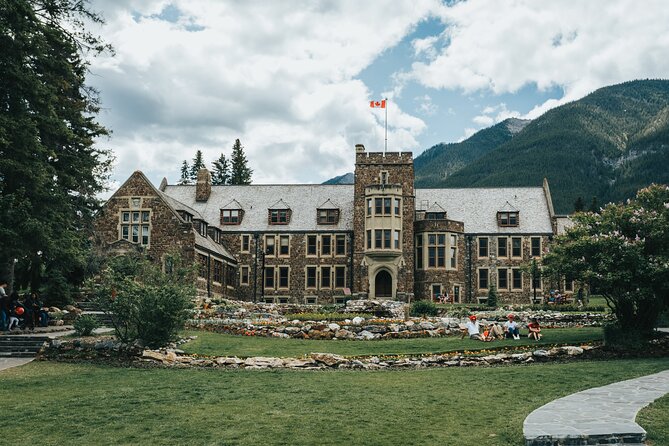
The route then reaches the Banff National Park Administration Building. Its appearance is part of the lesson, so stop and look closely while the commentary explains why the building matters. The audio format works well here because you can keep your eyes on the structure instead of reading a long panel on your phone.
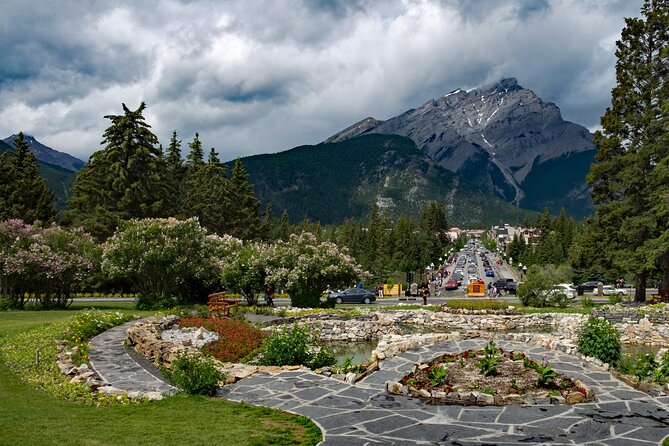
Next comes Cascade Gardens, a four-acre park terraced into the hillside. Built in the 1930s, it includes the Cambrian and Devonian pavilions. This is one of the strongest sections of the walk because it combines open space, garden design, and mountain-town history.
One practical point: the gardens can feel very different depending on the season. The tour description warns that recommended attractions can be closed or inaccessible at times. You can still follow the route, but the garden experience may be less rewarding outside the main visiting season.
Bow River views and small clues on Buffalo Street
The Banff Pedestrian Bridge gives you a pause beside the Bow River. The commentary introduces the person known as Mr. Banff, adding a personal angle to the town’s story while you look out over the water.
After that, the route uses small details to keep you alert. At the corner of Buffalo and Muskrat streets, look for the elevation marker set into the sidewalk. It looks like a coin, and the audio explains its purpose.
At 514 Buffalo Street, you’ll pass the Crandell Peck Cabin, built in 1907 by Edward Henry Crandell. It was made largely with local materials and is one of Banff’s oldest buildings. This is the kind of stop that benefits from audio guidance. Without a prompt, you could walk past an ordinary-looking cabin and miss the reason it matters.
The next points cover an inukshuk at Buffalo and Otter streets and the Banff Powerstation at 525 Buffalo Street. The powerstation helped supply streetlights and homes in 1905. These stops show how the route moves beyond postcard scenery and into the practical work of building a town.
You then follow Ken Madsen Path before reaching 117 Grizzly Street and the Tarry-a-while residence. This was the home of Mary Schaffer Warren, known for early exploration, writing, and painting in the Canadian Rockies. The route gives you a glimpse of the people who recorded and shaped Banff, not just the officials who ran it.
Mary Schaffer Warren, the Luxton home, and Banff’s early families
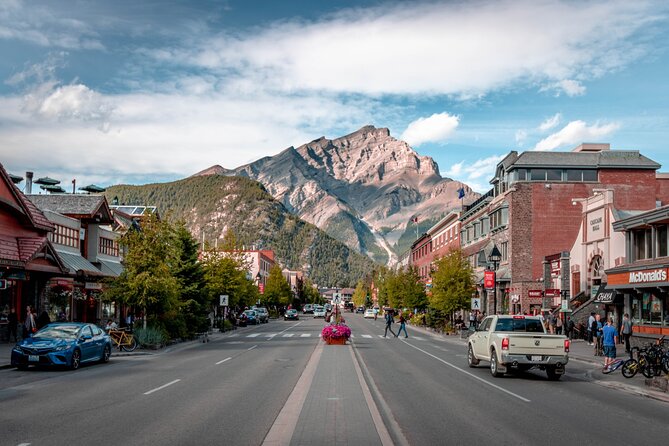
The section around Otter, Caribou, and Buffalo streets is less about one grand view and more about linking ordinary streets to local stories. The audio explains Banff’s climate as you move between stops, which may be especially useful during the colder months.
The Luxton Home Museum offers another chance to go inside a historic building. The house presents the life of a pioneer family and the changing town over nine decades. Admission is extra, and I would allow more than the five-minute audio prompt if you decide to visit.
The route then reaches Caribou Corner and recalls the Brewster family, who arrived in Banff in 1886 and set up shop nearby. This is a good reminder that Banff was not built only as a scenic resort. Families, businesses, and public services made the town function.
On Banff Avenue, the Four Sentries sculpture provides a public-art stop. A nearby mural depicts the Cave and Basin site, giving the guide a chance to explain one of the key places in Banff’s national park story. You will also pass the Banff Visitor Information Centre, where you can gather more information about other activities in the area.
The route includes St. Paul’s Presbyterian Church, built in 1930, though the congregation dates to 1887. At Banff Avenue and Elk Street, a stone fire monument becomes another short stop. These details may seem modest, but together they give the main streets more character.
More self-guided routes in Banff:
- Smartphone Audio Driving Tour between Banff and Calgary
★ 4.0 · 25 reviews - Self-Guided Audio Tours for the Canadian Rockies
★ 5.0 · 18 reviews - Discover the Rockies: 6 Self-Guided Smartphone Audio Tour Bundle
★ 4.0 · 10 reviews - 5-Day Banff Self-Guided package with Moraine & Lake Louise Tour
★ 4.5 · 8 reviews
From Cascade Lodge to Banff’s museums
At Caribou and Bear streets, you’ll see the old Cascade Lodge, now associated with the Banff Freemasons. The story adds another layer to a building you might otherwise treat as just part of the town’s streetscape.
The Whyte Museum of the Canadian Rockies is one of the most worthwhile optional stops. Its purpose is to preserve and make accessible the history and culture of the Rocky Mountains. Entry is not included, so decide in advance if you want a quick exterior orientation or a separate museum visit.
Central Park provides a pleasant change of pace. The commentary points out a large pile of rocks in the middle of the park, then explains why it is there. This is a good example of the tour’s light tone. Not every stop is a major monument, and the guide often uses small objects to keep the walk playful.
The Banff Park Museum is another optional indoor stop. Established in 1895, it was created to house mounted specimens of animals, plants, and minerals associated with the park. Admission is extra, and the five-minute audio segment should be treated as an introduction rather than enough time to see the museum.
At Banff Avenue and Buffalo Street, the Dave Whyte block gives you one of the oldest largely intact commercial buildings in town. At 107 Banff Avenue, Harmony Lane adds a fine example of rustic National Park architecture, including river-stone pillars.
Churches, park officials, and the final Banff Legion stop
Rundle United, also called Ralph Connor Memorial United Church, brings the route back to religious and community history. The guide uses a Mr. Rundle impersonation, which gives this section a bit of personality. If you prefer a strictly formal presentation, that style may not be for you, but it keeps the audio from sounding like a dry catalogue.
At Beaver and Buffalo streets, you’ll see the Superintendent’s Residence. The commentary explains the responsibilities of the park superintendent, who lived there. This stop helps connect Banff’s handsome buildings with the administration behind the national park.
The final named stop is the Royal Canadian Legion Colonel Moore Branch 26 and its cenotaph, built in 1920. It is a fitting end to a route that moves through Banff’s civic, commercial, cultural, and residential past.
The walk ends back at the starting point. Because the app lets you stop and restart, you do not have to treat the route as one continuous push. That is useful if you want to visit the Whyte Museum, take a meal break, or wait for better weather.
How the smartphone app works in practice
Before you leave, download the tour over Wi-Fi. The audio and route can then be used offline, so you do not need a signal or mobile data during the walk. You need to provide your own smartphone or tablet. Headphones are optional because the audio can play through the device speaker.
The live GPS map shows your position and the next points. As you approach a stop, the commentary should play automatically. After the audio, a location-based trivia question appears, and you tap your answer on the device.
That system has clear benefits. You can keep walking at your own pace, repeat a segment, pause for photographs, or skip ahead. You also avoid trying to hear a guide over a large group.
The weak spot is navigation. One useful improvement would be a clearer street map with all stops and directions. The map can show where you are without always making it obvious which way to walk next. A few people had trouble finding the recommended points, and one person found that the app repeatedly jumped from the map to a slogan page. The provider reported that a software bug connected with a new build had been fixed, but I would still download and open the tour before starting.
The tour is offered in English. Since the audio triggers by location, keep your phone accessible and listen for the prompt rather than walking quickly past a point.
Weather, timing, and who will enjoy this walk

Banff’s weather is a serious part of the decision. One attempt to complete the route took place at minus 19 degrees, making it tempting to drive rather than walk. That is not a minor inconvenience. A GPS audio tour loses much of its value if you are trying to stay warm in a vehicle or rushing between stops.
I would choose a milder day and wear shoes suited to a 5 km walk. The supplied information does not promise special winter access or indoor alternatives, so check conditions and attraction hours before setting out. If a garden, museum, or other recommended site is closed, you can still continue along the public route, but you may miss part of the experience.
This tour suits you best if you:
- Want a cheap introduction to Banff’s central streets.
- Prefer exploring alone or with your own small group.
- Like to pause, restart, and set your own pace.
- Enjoy architecture, public art, local families, and civic history.
- Are comfortable using a phone map and audio app.
I would be more cautious if you need precise turn-by-turn directions, dislike looking at a phone while walking, or want a live guide who can answer questions. The route is private in the simple sense that only your group participates, but there is no person present to correct your course or add detail on the spot.
Confirmation arrives at booking, free cancellation is available up to 24 hours before the start time, and service animals are allowed. The tour is near public transportation, and most people can participate. The number of people selected at booking equals the number of devices allowed to download the tour, so plan accordingly if you are walking as a group.
Should you book The Sights of Banff?
I would book this for $8.22 if you want a flexible first look at Banff and are happy to manage your own phone. The strongest parts are the low price, offline access, Cascade Gardens, the historic cabins and homes, and the steady stream of small details you could easily miss.
I would not book it as your only Banff activity. The audio cannot replace entering the museums, and the navigation has not been perfectly smooth. Choose a comfortable-weather day, download the app early, test the map before leaving, and allow more than the advertised 60 to 90 minutes if you plan to stop indoors.
For independent walkers who value freedom over polish, this is a sensible little orientation tour. For anyone wanting flawless directions and a personal storyteller, spend more on a live walk.
FAQ
How long is The Sights of Banff tour?
The walk is described as approximately one to one and a half hours and covers about 5 km round trip. You can take as long as you like because there are no time constraints.
Where does the tour begin and end?
It begins at 12 Banff Avenue in Banff, Alberta, and ends back at the meeting point.
Do I need mobile data during the walk?
No. You can download the tour over Wi-Fi before starting. Once downloaded, no signal or mobile data is required during the tour.
Is a smartphone included?
No. You must provide your own smartphone or tablet. Headphones are optional because the audio can play through your device speaker.
Are museum admission fees included?
No. Admission is not included for Buffalo Nations Museum, the Luxton Home Museum, the Whyte Museum of the Canadian Rockies, or Banff Park Museum.
Can I cancel the tour for a refund?
Yes. You can receive a full refund if you cancel at least 24 hours before the experience start time. Cancellations or changes made within 24 hours are not accepted for a refund.
More Audio Tours in Banff
- Banff Cave & Hot Springs Audio Walking Tour (Not a Ticket)
★ 3.0 · 6 reviews - Icefields Parkway: a Smartphone Audio Driving Tour
★ 4.0 · 118 reviews - Cabot Trail: a Smartphone Audio Driving Tour
★ 4.5 · 118 reviews - Niagara: Behind The Falls, Skylon Tower Ticket & Tesla Audio Tour
★ 3.5 · 69 reviews
Just added around Banff
- Jasper to Banff One-Way Tour★ 5.0 · 76 reviews
- Sunset at Moraine Lake & Stargazing Tour from Canmore/Banff★ 5.0 · 95 reviews
- 2 Day Banff Lake Louise Johnston Canyon Gondola Cave Basin tour★ 4.5 · 8 reviews
- Banff/Canmore Moraine Lake & Lake Louise– Hike, Canoe or Sightsee★ 5.0 · 104 reviews
- Full Day Private Tour Banff/Yoho Customized Sightseeing★ 4.5 · 31 reviews
- Shared Tour: Lake Louise & Emerald Lake from Canmore/Banff★ 4.5 · 5 reviews
- Sunrise at Moraine Lake & Lake Louise from Calgary/Canmore/Banff★ 4.5 · 13 reviews
- Moraine Lake and Lake Louise day Tour from Canmore and Banff★ 5.0 · 9 reviews
Banff Tours, compared.
Lake Louise, Moraine Lake, Banff Tour from Calgary/Canmore/Banff
Read our review →
Emerald Lake, Moraine, Louise, Johnston Canyon & Banff Town
Read our review →
Lakes Moraine, Louise, Emerald, Johnston Canyon & Yoho Tour
Read our review →
Lake Louise, Moraine Lake and the Icefields Parkway Full-Day Tour
Read our review →
Lake Louise, Moraine, Emerald Lake & Johnston Canyon
Read our review →
Browse the lists this tour appears in