
Review · MONTREAL
A Walking Tour of Old Montreal
Old Montreal makes its best first impression at Place d’Armes, where the basilica, banks, churches, and older stone buildings gather in one view. This tour uses that square to explain how four eras, First Nations, French, British, and Canadian or Quebec, shaped one compact part of the city.
I like the private group format and the way the walk links grand landmarks with ordinary city life, including markets, banks, and working streets. I also like that the route includes the sailors’ chapel and a viewpoint at Pointe-à-Callière, not just the usual postcard stops. The main consideration is that the two-hour tour moves quickly, and entrance to the basilica costs an additional $16 per adult.
Key points to know before you book
- Place d’Armes brings four eras together: The square offers the clearest single view of Old Montreal’s changing architecture and civic life.
- The route includes the sailors’ chapel: This smaller religious site adds a more personal maritime layer to the city’s story.
- History reaches beyond French beginnings: You’ll hear about First Nations, British rule, the US Revolution, Canadian and Quebec identity, and Charles de Gaulle’s famous speech.
- A private group of up to 12 keeps the walk personal: At $146 per group, the price becomes more attractive when shared by several people.
- Pointe-à-Callière adds a city view: The observation deck gives you a chance to look over Montreal after seeing its streets at close range.
- Nicola Zoghbi leads in three languages: English, French, and German are available, though you should select the language you need when booking.
Why Old Montreal works so well on foot
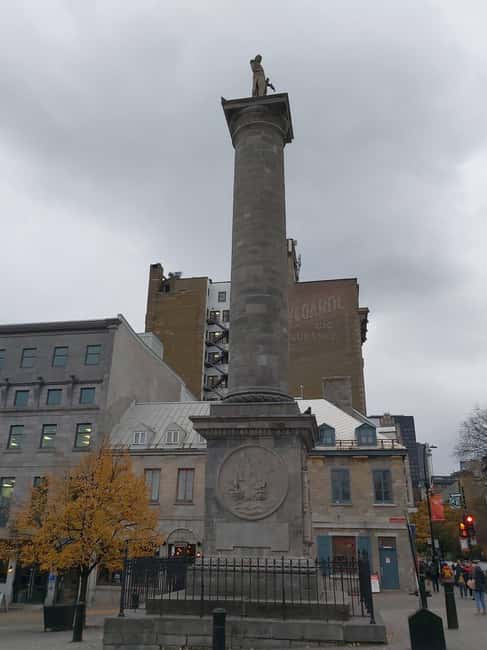
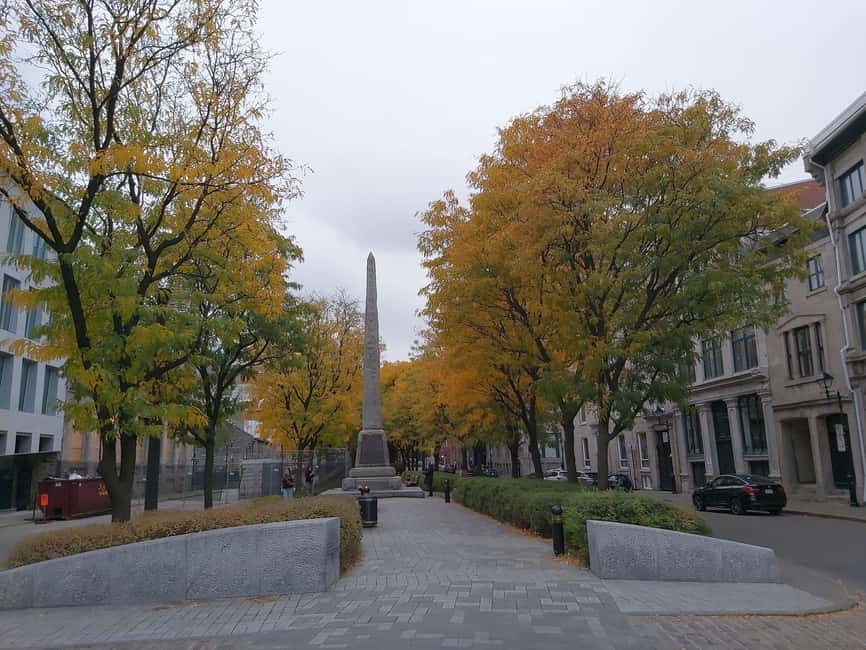
Old Montreal is compact enough to explore by walking, yet its streets carry several different versions of the city. In a short distance, you can pass churches, banks, markets, and buildings from different centuries.
That variety is the point of this experience. You are not simply looking at old façades. You are learning how Montreal changed from a First Nations setting to a French settlement, then a British city, and finally a Canadian and Quebec metropolis.
I like tours that explain why a place looks the way it does. This one uses architecture and public spaces as the guidebook. A stone building may tell you about religion, trade, government, or shipping, while a later structure can show how Montreal adjusted to British power and modern Canadian life.
The cobblestones add atmosphere, but they also affect comfort. Wear shoes with good support. Old streets are part of the experience, not a smooth museum floor, and weather can change how pleasant the walk feels. Bring clothing suited to the forecast, especially if you are visiting during a cooler or wet period.
More Old Montreal walks:
- Old Montreal Small-Group Walking Tour | Max 10 | by MTL Detours
★ 5.0 · 2,088 reviews - Old Montreal: Traditional Ghost Walk of the Haunted City
★ 4.7 · 746 reviews - Old Montreal Ghost Walking Tour
★ 4.5 · 726 reviews
Place d’Armes, where Montreal’s past gathers
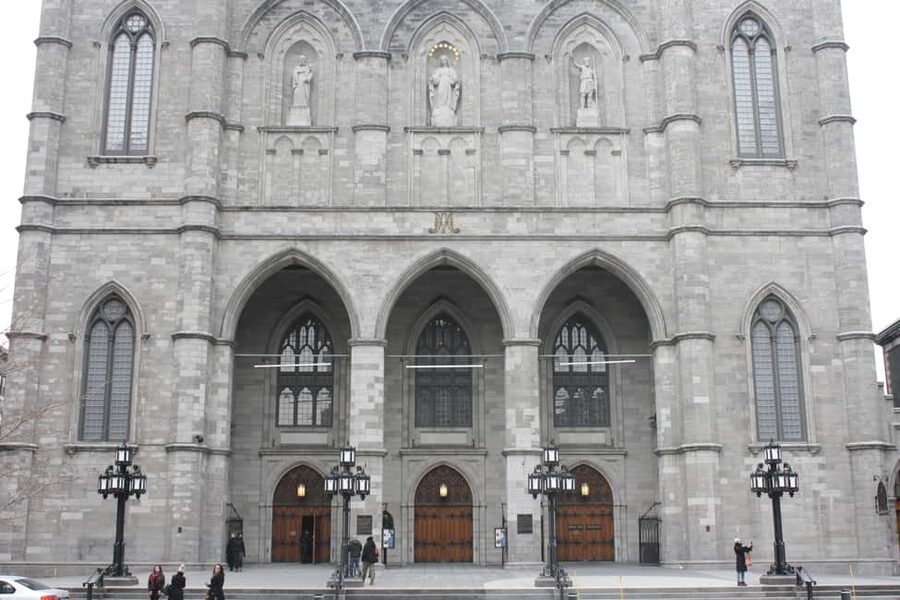
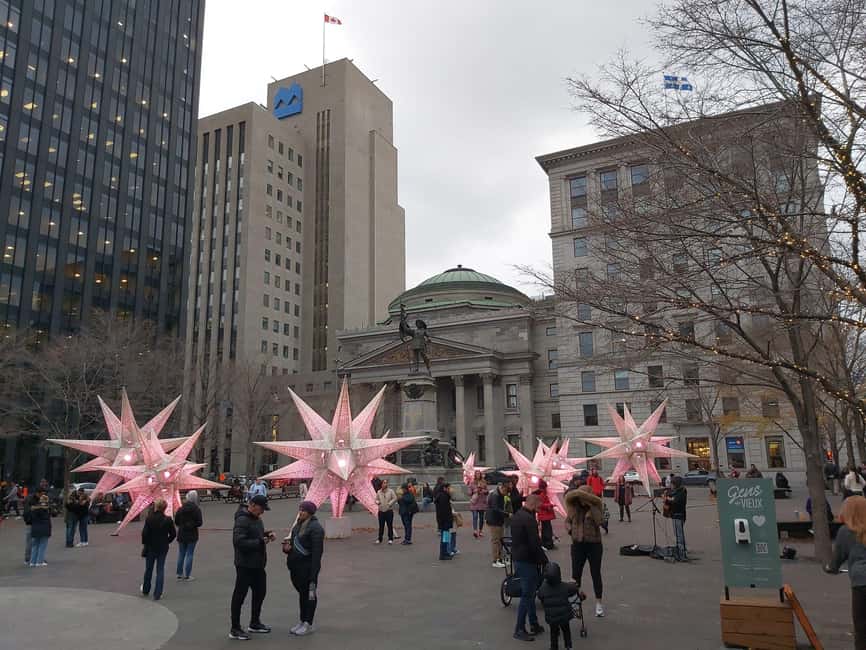
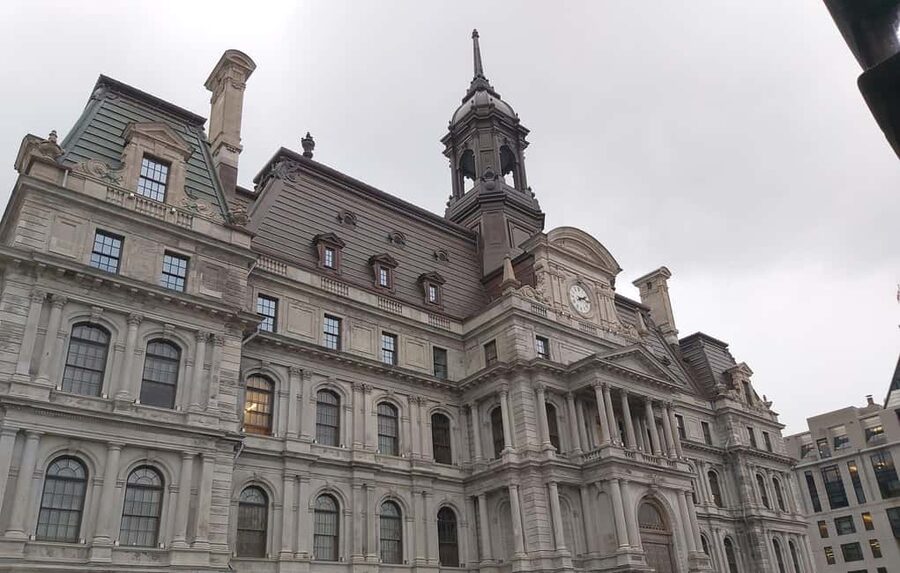
The tour’s most important visual moment comes at Place d’Armes, directly across from Notre-Dame Basilica. This is where the walk’s four historical periods make the most sense as one picture.
You can look around the square and see how buildings from different eras sit side by side. Religious buildings, financial institutions, and other civic structures give the space a layered character. Instead of treating each building as an isolated monument, the guide can show you how they belong to different stages of Montreal’s growth.
This is a good place to pay attention to contrasts. The square is not valuable only because one building is old. It shows how Montreal kept building over time, adding new forms and institutions without erasing the earlier city.
The basilica is the most obvious landmark here, but the walking tour does not include entry. You can add an interior visit for $16 per adult if you want to see it from inside. That extra cost is worth considering separately, since the tour itself focuses on the wider setting and the city’s development.
If you have only a short time in Montreal, Place d’Armes gives you a useful frame for the rest of your visit. After this stop, you should have a clearer sense of why Old Montreal feels different from newer parts of the city.
Four eras explained through streets and buildings
The tour is built around four chapters: First Nations, French, British, and Canadian or Quebec. That structure keeps the story from becoming a simple tale of French settlement followed by modern Montreal.
The First Nations chapter matters because it places the city’s story before the stone streets and European buildings. It reminds you that Montreal did not begin with the architecture you see today.
The French era explains the city’s early identity and the forms that still define Old Montreal. Churches, markets, and commercial buildings help show how a settlement grew into an urban center.
The British period brings a different political and cultural influence. The walk also touches on the US Revolution, giving you a wider North American frame rather than treating Montreal as an isolated place.
The final Canadian and Quebec chapter connects the older city to the identity you encounter today. This is also where the tour can place Charles de Gaulle’s speech in context. His words became an important moment in Quebec’s modern political story, and hearing about it while walking through the old city gives the event a physical setting.
I appreciate this broad approach because it keeps the tour from becoming a list of dates. You get political events, public memory, architecture, religion, trade, and everyday city life in the same walk.
The sailors’ chapel and a smaller side of the city
Entering the sailors’ chapel is one of the more distinctive parts of the route. It offers a change of scale after the larger buildings and public spaces around Place d’Armes.
The chapel connects Old Montreal with its maritime past. Even without a long stop, the setting helps you think about the people whose work brought goods, news, and change into the city. It also adds a human touch to the tour. Grand churches and banks can make history feel distant, while a chapel associated with sailors suggests the daily lives of workers and visitors.
This is the kind of stop I value on a city walk. It may not take as much time as the basilica, but it gives the route a different mood and subject. You are not only seeing the institutions that shaped Montreal. You are also considering the people who moved through it.
The exact amount of time spent inside each stop can depend on the guide and the pace of your group. With only two hours, you should expect an overview rather than a long museum-style visit at every location.
More walking tours in Montreal:
- The Original Old Montréal Walking Tour by Guidatour
★ 4.5 · 2,217 reviews - Montréal: The Original Old Montréal Walking Tour
★ 4.8 · 911 reviews - The Essential 101 Non-Touristy Walking Tour by Spade & Palacio
★ 5.0 · 716 reviews - Montreal: Top Rated Small Group Old Montreal Walking Tour
★ 4.9 · 611 reviews
Pointe-à-Callière for a look across Montreal
The route includes time at the observation deck of Pointe-à-Callière museum. From there, you can look at Montreal from above after spending much of the tour at street level.
That change in viewpoint matters. On the ground, you notice stone walls, doors, religious buildings, and the uneven texture of the old streets. From the observation deck, the city’s arrangement becomes easier to read. You can connect the historic district to the larger urban setting.
Do check what is included before assuming you have full museum admission. The activity includes the walking tour and guide, while the information provided does not list museum entry as a separate inclusion. The observation deck is part of the route, but any additional admission details should be confirmed when you choose your option.
For some people, this will be the tour’s best photo opportunity. For others, the value is more practical. The view helps you understand that Old Montreal is not a preserved village sitting apart from the city. It is one historic district within a larger, living urban center.
History with political and public drama
A good city tour needs more than old buildings. This one adds two events that widen the story: the US Revolution and Charles de Gaulle’s speech.
The US Revolution helps place Montreal within the political changes of eighteenth-century North America. It shows that the city’s history was connected to events beyond its own streets.
De Gaulle’s speech moves the story into the modern period and the question of Quebec’s identity. Mentioning it during a walk through Old Montreal links public memory with place. Political history can feel abstract when you hear it in a classroom, but it becomes easier to picture when you are standing among the buildings and squares where Montreal’s public life developed.
These subjects also make the tour a better choice for adults who want context, not just pretty architecture. Families with older children may find the mix of revolution, religion, shipping, and politics easier to remember than a string of construction dates.
A private tour for up to 12 people
The price is $146 for a group of up to 12 people. That is not the cheapest way for one person to see Old Montreal, but it can be good value for a family or small group.
For example, six people would pay about $24 per person before any extra costs. A full group of 12 would bring the price to roughly $12 per person. You are paying for a private guide rather than joining a large public walk, so the value improves as your group gets bigger.
A private format can also make it easier to ask questions and adjust the pace within reason. You can focus on architecture, religion, politics, or daily life depending on what interests your group. Still, the walk lasts only two hours, so do not expect an exhaustive tour of every street in Old Montreal.
Nicola Zoghbi is the named provider, and the experience is offered in English, French, and German. One published booking from October 15, 2025 specifically praised Nicola’s friendliness and detailed explanations. That gives you a useful sense of the intended style: personal, explanatory, and attentive rather than a quick march between landmarks.
The published score is 3.8 from four ratings, a small sample that should not carry too much weight. I would judge this experience mainly by its private format, route, language options, and the fact that it combines major sights with less obvious stops.
Where the walk begins and ends
The starting point depends on the option you select. That makes it important to check the exact meeting instructions before setting out, since the walk does not have one universal pickup point.
The tour finishes at Place Jacques-Cartier. This is a useful ending because it leaves you in a central part of Old Montreal rather than returning you to a pickup point outside the district.
You can use the end of the tour as a springboard for more time in the area, but the tour itself does not include transport. Plan on arriving at the start on your own and continuing on foot afterward.
The route’s finish also gives the walk a natural shape. You begin with orientation and the city’s older layers, then move through major buildings, religious and maritime history, wider political events, and finally arrive at one of Old Montreal’s best-known public spaces.
Who will get the most from this tour
I would recommend this walk to first-time visitors who want a clear introduction to Old Montreal without spending half a day in a museum. The four-era structure gives you a simple way to remember what you have seen.
It also suits families, couples, and friends who want a private experience. With up to 12 people in one group, the price can work especially well for a family reunion or a small group of friends.
History-minded visitors should appreciate the range of subjects. You get First Nations, French, British, Canadian and Quebec identity, the US Revolution, maritime life, religion, and a modern political reference in one compact route.
The tour may be less suitable if you want a long interior visit at the basilica or a full museum program. The basilica costs extra, and the walk itself is designed as a guided overview. It is also not the best choice if you dislike cobblestones or prefer to explore at your own unhurried pace.
Practical advice for a better two hours
Wear comfortable shoes with enough support for uneven streets. Choose weather-appropriate clothing, since this is an outdoor walking experience with time spent moving between sites.
Keep your expectations realistic. Two hours is enough to understand the shape of Old Montreal and see important locations, but not enough to study every building or spend extensive time inside each attraction.
If the basilica matters to you, budget the additional $16 per adult and confirm how you want to fit that visit around the tour. The included experience is the guide and walking route, not basilica admission.
The tour offers free cancellation up to 24 hours before the start, and you can reserve now and pay later. Those terms are useful if your Montreal schedule is still shifting.
Should you book A Walking Tour of Old Montreal?
Book it if you want a private, two-hour introduction that explains why Old Montreal looks the way it does. The best features are the Place d’Armes overview, the four-era story, the sailors’ chapel, the Pointe-à-Callière viewpoint, and the chance to hear about events from the US Revolution to de Gaulle’s speech.
The $146 price makes the most sense for a group rather than a solo visitor. Share it among several people and you get a personal guide, three language options, and a route that goes beyond the standard basilica photo stop.
Skip it if you want full admission to several attractions, a leisurely half-day visit, or a self-guided walk with no fixed pace. For everyone else, it is a sensible way to get your bearings in Old Montreal while leaving plenty of time afterward for your own discoveries.
FAQ
Where does A Walking Tour of Old Montreal take place?
The experience takes place in Old Montreal, Quebec, with the guided walk covering historic streets and landmarks in the district.
How long does the walking tour last?
The guided tour lasts two hours.
What is the price?
The price is $146 per private group of up to 12 people.
Is the tour private?
Yes. It is offered as a private group experience for up to 12 people.
What languages are available?
The live guide is available in English, French, and German.
Who provides the tour?
The experience provider is Nicola Zoghbi.
Where does the tour finish?
The walk finishes at Place Jacques-Cartier.
Is entry to Notre-Dame Basilica included?
No. Basilica entry is optional and costs $16 per adult.
What should I bring?
Bring comfortable shoes and clothing suited to the weather.
Just added around Montreal
- Winter Express: Old Montreal Highlights Walking Tour★ 5.0 · 119 reviews
- Under the Surface of Montreal’s Chinatown: Guided Food Walking Tour★ 5.0 · 23 reviews
- Full Day Family Bike Rental★ 5.0 · 17 reviews
- Montreal Premium Driving Tour with River Cruise and Notre Dame★ 4.5 · 164 reviews
- Immersive Virtual Reality Game Activity★ 5.0 · 19 reviews
- Montréal Downtown and Underground City Private Walking Tour★ 5.0 · 47 reviews
- Day at Mont-Tremblant National Park★ 4.0 · 5 reviews
- In the Shadow of the Mountain: Montreal Jewish History Walking Tour★ 4.5 · 33 reviews
Montreal Tours, compared.


Montreal Mile End Authentic Food Tour with 7 Delicacies Tastings
Read our review →
Quebec City and Montmorency Falls Day Trip from Montreal
Read our review →
The Original Old Montréal Walking Tour by Guidatour
Read our review →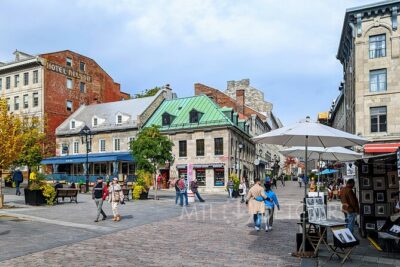
Old Montreal Small-Group Walking Tour | Max 10 | by MTL Detours
Read our review →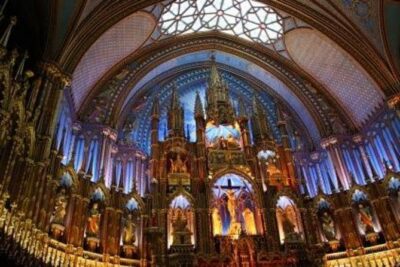
Montreal City Sightseeing Tour with Live Commentary
Read our review →
Browse the lists this tour appears in