
Review · MONTREAL
Rabbis, Writers and Radicals: Montreal Jewish History Walking Tour
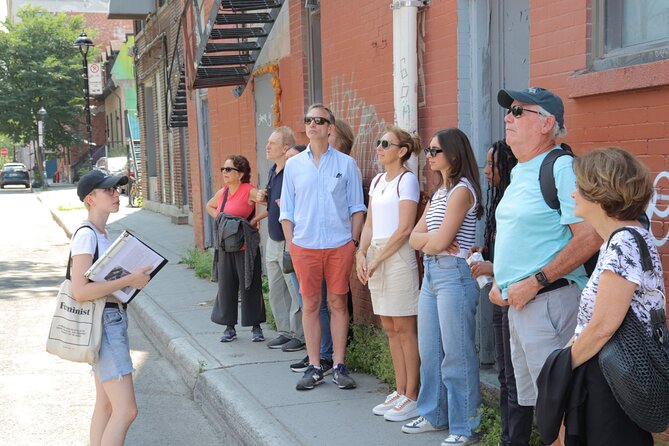
Montreal’s Jewish story is written into ordinary streets, old storefronts, apartment blocks, and places where a community once lived but no longer does. This two-hour walk through the Plateau and Mile End looks past the postcard Montreal to explore Ashkenazic immigration, religious disputes, class divisions, and the city’s once-thriving Jewish quarter. I like that the tour tackles subjects many city walks skip, including the padlock laws and anti-Zionist Jewish thought.
I also like the human scale. You walk with a local guide, stop to ask questions, and cover a lot in a short time. Guides such as Serafina, Sofia, Vivien, Hannah, and Emily have been praised for their warmth, clear explanations, and care with older walkers. The main drawback is that the quality can depend on the guide’s pace and presentation. Some sessions feel lively and connected, while others can seem like a dry lecture supported by notes and old photographs.
Key points to know before you book
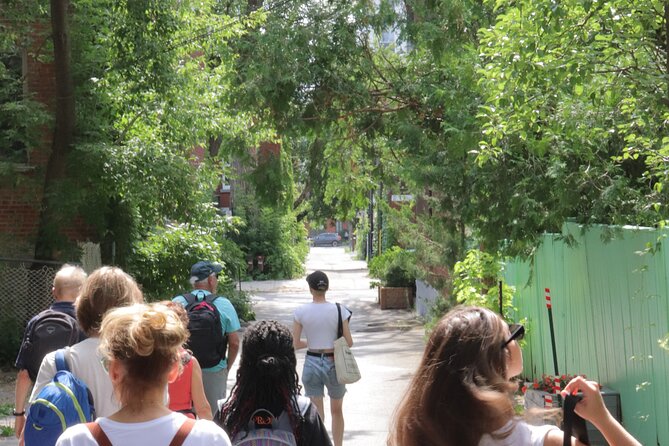
- Montreal’s Jewish past appears in everyday streets: The tour focuses on the Plateau and Mile End, where traces of an older community remain among present-day city life.
- Padlock laws and anti-Zionist Jews add unusual depth: These subjects give the walk a sharper edge than a simple story of immigration and synagogues.
- Expect a history walk, not a museum visit: The route does not begin at the Museum of Jewish Montreal, and the museum’s exhibitions require separate visiting hours.
- Guides make a real difference: Serafina, Sofia, Vivien, Hannah, and Emily have each been praised for strong communication and personal attention, though one guide was criticized for reading too closely from a book.
- The route takes about two hours: You need a moderate level of fitness, and the group can include up to 20 people.
- At $24.03, the price is reasonable for a focused city walk: The value is strongest if you want context and stories, not a long list of grand buildings.
Why Montreal’s Jewish story works best on foot
Montreal’s Jewish past is not confined to one landmark. It is spread across a section of the city where streets, businesses, homes, and community institutions changed over time. That makes walking the right format. You can see how the old Jewish quarter fits into the wider Plateau and Mile End, rather than treating it as a separate chapter in a museum display.
The tour’s title points to its broad range. Rabbis suggest religious life and debate. Writers point to the cultural world that grew around Jewish Montreal. Radicals hint at politics, labor, secularism, and arguments over Zionism. This is not only a story of people arriving, opening shops, and building institutions. It also asks how Jewish Montrealers argued among themselves and responded to the city around them.
I especially value the attention given to groups that do not always get much space in standard city tours. The subject of anti-Zionist Jews, for example, complicates any simple account of Jewish political life. The padlock laws offer another useful window into Montreal society and the pressures placed on families, landlords, and communities.
You should come ready to listen more than to sightsee. Some of the physical remains are modest. You may be looking at a street corner, an older building, or a location that has changed beyond easy recognition. The guide’s explanation is what turns those places into meaningful stops.
More history-led days in Montreal:
- Montreal History Guided Sightseeing Cruise
★ 3.5 · 363 reviews - Making Their Mark: Montreal Jewish History Walking Tour
★ 5.0 · 166 reviews - In the Shadow of the Mountain: Montreal Jewish History Walking Tour
★ 4.5 · 33 reviews
Starting near Saint-Laurent Boulevard
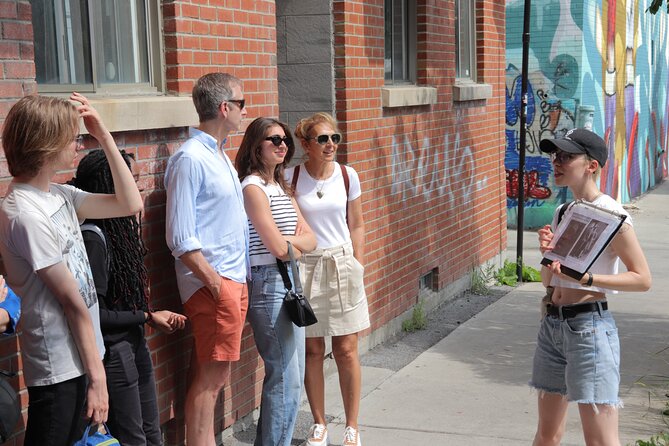
The published starting information needs careful attention. The meeting point is given as 4129 Boulevard Saint-Laurent, while the additional tour information says the tour begins and ends at 4040 Boulevard Saint-Laurent. The listed end point is 5220 Boulevard Saint-Laurent, at the Museum of Jewish Montreal. Since the tour starts and ends at different locations around the Plateau and Mile End, check the exact address on your ticket before setting out.
The important practical point is that you should not automatically go to the museum building for the start. The museum’s exhibitions at 5220 Saint-Laurent are separate from the walking route and have their own opening schedule. The walk may finish there, but the tour itself does not begin inside the museum.
Saint-Laurent Boulevard is a fitting spine for this experience. It connects the Plateau and Mile End, two areas strongly tied to Montreal’s immigrant and working-class past. Starting in this part of the city places you among the streets where Jewish life developed, rather than beginning with a display case and then moving outward.
Give yourself time to find the starting spot. Saint-Laurent is a busy urban street, and the difference between a nearby address and the precise meeting place matters when a group is ready to leave. Public transportation is nearby, but hotel pickup and drop-off are not included.
Tracing Ashkenazic immigration through the Plateau
One of the tour’s central subjects is the arrival and settlement of Ashkenazic Jewish immigrants. The walk focuses on the older Jewish presence in Montreal and the ways that community shaped local streets and institutions.
The useful thing about covering this story on foot is the connection between movement and place. Immigration is not presented only as a date or a population figure. You begin to consider where people lived, how neighborhoods formed, and what happened when a once-central community shifted elsewhere.
The physical evidence can be uneven. Some places remain recognizable, while others survive mainly through photographs and the guide’s account. That is not necessarily a weakness. It gives you a more honest sense of how cities change. A community can leave a lasting mark without leaving behind a perfectly preserved district.
Still, expectations matter. If you want a parade of major buildings with dramatic interiors, this may feel restrained. The attraction is the story beneath the modern street. You are paying for interpretation and context, not a series of grand entrances.
The route also appears to touch on everyday life, though the amount of detail can vary. One assessment wanted more stories about ordinary Jewish life and more attention to dates and major events. That is useful advice. The tour has strong subjects, but it may not provide the same level of domestic detail at every stop.
Rabbis, writers, and political arguments
The most interesting part of the walk is its willingness to show disagreement. Jewish Montreal was not one unified block, and the tour explores that fact through religious and political themes.
The reference to rabbis opens the door to religious authority and community structure. The writers point toward intellectual and cultural life. The radicals suggest that some Montreal Jews challenged accepted political and religious positions. The discussion of anti-Zionist Jews is particularly valuable because it shows that Jewish political identity was debated from within the community itself.
The padlock laws are another memorable subject. This was singled out as one of the tour’s strongest topics, and it helps explain the social pressures surrounding rented rooms and private life in Montreal. Rather than giving you only a general account of discrimination or urban hardship, the topic points to a specific policy and its effects.
The class divide within Montreal’s Jewish community also deserves attention. A wealthier Jewish population and poorer immigrant workers did not experience the city in the same way. The tour has the ingredients for a strong account of that divide, though the amount of time devoted to it may depend on the guide.
This is where a good guide earns the fee. A list of facts about anti-Zionism, padlock laws, and class would be dry. A clear explanation of how those issues fit together can show you why they mattered. Ask questions if the route moves too quickly past a subject that interests you.
More walking tours in Montreal:
- The Original Old Montréal Walking Tour by Guidatour
★ 4.5 · 2,217 reviews - Old Montreal Small-Group Walking Tour | Max 10 | by MTL Detours
★ 5.0 · 2,088 reviews - Montréal: The Original Old Montréal Walking Tour
★ 4.8 · 911 reviews - Old Montreal: Traditional Ghost Walk of the Haunted City
★ 4.7 · 746 reviews
The guide shapes the experience
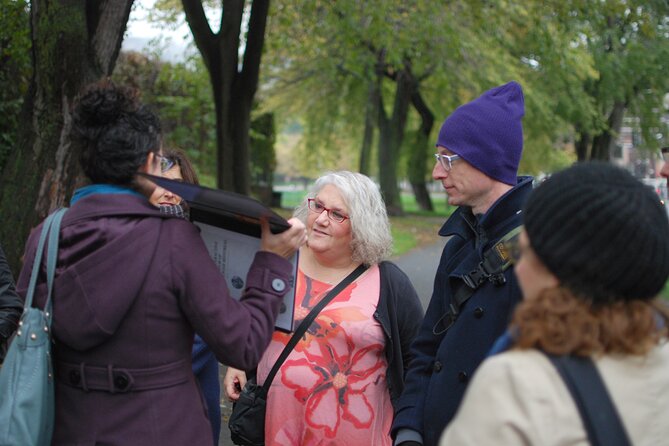
The guide is the biggest variable here. The strongest guide descriptions point to warmth, patience, and the ability to explain difficult material in plain English.
Serafina has been praised for being friendly, thorough, and open to other people’s experiences. That last quality matters on a subject tied to family background, religion, and identity. Sofia has been described as enthusiastic and well informed, with the ability to make the tour a high point of a Montreal visit. Vivien has also received strong praise for combining clear knowledge with a pleasant manner.
Hannah’s style included personal observations and small techniques to keep the group engaged. That can make a street-based history walk feel more immediate. She was also careful to maintain a pace suitable for older walkers without letting the group drag.
There are two cautions. First, one guide spoke too quickly for some non-native English speakers. Second, another session felt dependent on reading from a book and showing pictures of places that no longer exist. If you are not fully comfortable with spoken English, a fast guide may make the experience harder to follow.
Group size can reach 20 people. That is still manageable for a walking tour, but hearing becomes important. One criticism called for some form of amplification and noted that the guide needed to slow down and enunciate. Stand close to the guide when possible, and ask for repetition if a point gets lost.
The range of guide experiences does not make the tour a bad choice. It simply means you should judge the experience as a live history walk, not a fixed audio program. The person leading the route affects the rhythm, detail, and sense of connection.
What the two-hour route can and cannot cover
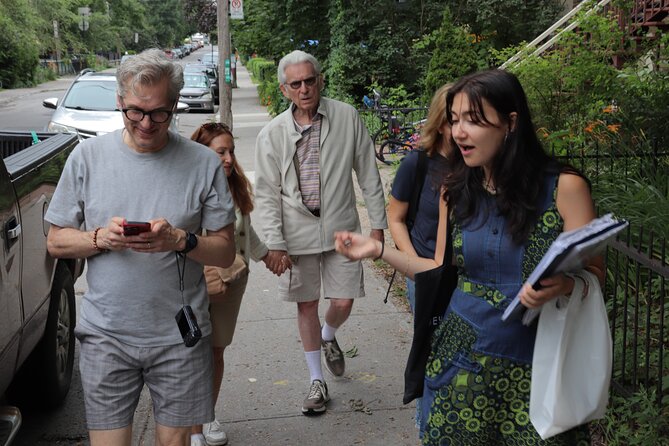
Two hours is a useful length for this subject. It is long enough to move beyond a quick introduction, yet short enough to fit into a day of sightseeing. The route covers a great deal, and several accounts describe the guide as fitting a large amount of history into just over two hours.
That broad reach also creates a tradeoff. The tour may touch on immigration, religious life, writers, radical politics, class, anti-Zionism, padlock laws, and the decline or movement of the old community. Each subject could fill an entire lecture. In two hours, some topics will receive a clear explanation while others may feel like brief pieces of a larger story.
I would approach the walk with one or two subjects in mind. If the padlock laws interest you, ask for more detail. If you want to understand the class divide, bring it up. If you care most about daily life, ask how families, workers, or shopkeepers used the neighborhood. A focused question can turn a passing reference into the part you remember.
The pace is generally suitable for a moderate fitness level. One guide was praised for allowing seniors to keep up and for being considerate about stopping. Even so, this is a walking tour, not a seated talk. Wear comfortable shoes and be prepared to spend most of the two hours outdoors.
The Museum of Jewish Montreal at the end
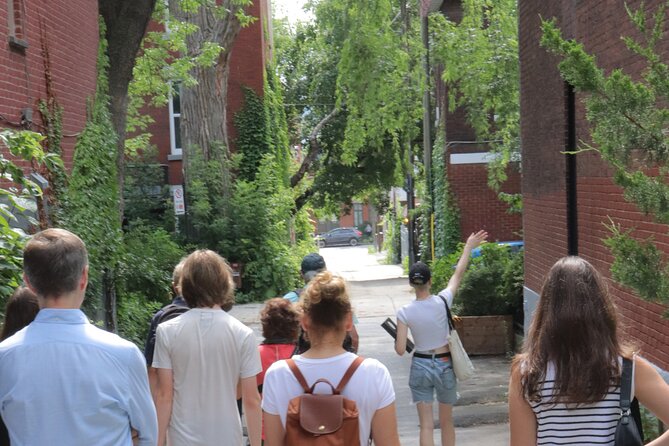
The tour finishes near, or according to one set of directions at, 5220 Saint-Laurent Boulevard, where the Museum of Jewish Montreal is located. This is useful because you can connect the street walk with the museum’s exhibitions, but the admission and opening times should be treated separately.
The museum exhibitions are open Thursday through Sunday, with Monday opening added beginning in late May 2024 according to the supplied information. Check the museum’s current schedule before planning your visit, since the walk itself does not guarantee that the exhibition space will be open when you arrive.
Ending at the museum gives you a sensible next step. If the guide has introduced people, events, and institutions that you want to explore further, an exhibition can provide objects and images to support the street-level story. If the museum is closed, you can still finish the walk with a better understanding of the neighborhood, but you should not count on entering.
The route’s separate start and finish also affect your day. You will not simply return to your starting point, so plan your next activity around the end of the walk. Saint-Laurent Boulevard and the surrounding neighborhoods make it easy to continue exploring on foot or by public transportation.
Is $24.03 a fair price?
At $24.03 per person, this is a modestly priced activity for a two-hour guided walk. The local guide is included, while hotel pickup and drop-off are not. You are paying for a focused interpretation of Montreal’s Jewish past rather than transport, food, or entry to a major attraction.
I think the value is good if you enjoy urban history and are willing to notice small clues. The tour can help you see the Plateau and Mile End with new questions. It also covers unusual subjects that would be hard to assemble on your own in a single afternoon.
The value is weaker if you want a polished theatrical presentation or a large number of preserved historic interiors. Some stops are remnants, altered places, or locations that need photographs and explanation. A person mainly interested in architectural spectacle may find the sights less remarkable.
The 92 percent recommendation rate and 4.6 rating suggest a generally strong experience, but the spread of opinions is important. Most high marks focus on the guide’s warmth, clear communication, and ability to explain a large amount of material. The low marks focus on a guide relying too heavily on notes, limited depth, or a story that did not feel connected.
That makes the price a reasonable gamble, especially with free cancellation up to 24 hours before the start time. If your schedule changes inside that window, you can cancel for a full refund. Changes or cancellations made less than 24 hours before the start time are not accepted for a refund.
Who should book this Montreal walk?
I would recommend it to you if you like history that sits beneath the modern city. It suits couples, solo visitors, families, and anyone with a personal or academic interest in Jewish life, migration, religious debate, or Montreal’s changing neighborhoods.
It is also a good pick if you want a short activity with local guidance. The two-hour length leaves room for another museum, meal, or neighborhood walk. The route’s location makes it easy to build into a day around the Plateau and Mile End.
Families can join, but the subject is serious and the experience is built around listening. Children who enjoy stories about neighborhoods, rules, and people may find it worthwhile. Children who need constant visual action may lose interest when a location is explained through photographs or spoken history.
I would be more cautious if you need a slow, amplified presentation in English. The tour is offered in English, and guide pace can vary. If hearing every word is important, stay near the front and confirm any special needs when booking.
Should you book Rabbis, Writers and Radicals?
Book this tour if you want the human and political story of Montreal’s Jewish community, not just a quick look at old buildings. Its best material includes Ashkenazic immigration, padlock laws, anti-Zionist Jews, class divisions, and the remains of a community woven into the Plateau and Mile End.
Skip it if you want a tightly scripted route with a guaranteed performance style. The guide matters, and some sessions may feel more like a history lecture than a fully connected walk. At $24.03, though, the cost is low enough to make sense for curious visitors who value context and can accept that some evidence has disappeared.
Check your meeting address carefully, bring comfortable shoes, and use the museum as a possible follow-up rather than assuming it is part of the walking tour admission. If those conditions suit you, this is a worthwhile way to look at Montreal through a less familiar and more revealing story.
FAQ
How long is the Rabbis, Writers and Radicals walking tour?
The tour lasts approximately two hours.
Where does the tour begin?
The listed meeting point is 4129 Boulevard Saint-Laurent in Montreal. The additional tour information also refers to 4040 Boulevard Saint-Laurent, so you should follow the exact address shown on your ticket.
Where does the tour end?
The listed end point is 5220 Boulevard Saint-Laurent, home of the Museum of Jewish Montreal. The tour information also says that routes may begin and end at different locations around the Plateau and Mile End.
Does the tour start at the Museum of Jewish Montreal?
No. The walking tour does not begin at the museum building. Check your ticket for the current meeting location.
Is admission to the museum included?
No museum admission is listed as included. The tour includes a local guide, while the museum exhibitions have separate opening hours.
What language is the tour offered in?
The tour is offered in English.
How many people can join the tour?
The activity has a maximum group size of 20 people.
Is hotel pickup and drop-off included?
No. Hotel pickup and drop-off are not included.
Can I cancel for a full refund?
Yes. You can cancel at least 24 hours before the experience start time for a full refund. Cancellations or changes made less than 24 hours before the start time are not accepted for a refund.
Just added around Montreal
- Winter Express: Old Montreal Highlights Walking Tour★ 5.0 · 119 reviews
- Under the Surface of Montreal’s Chinatown: Guided Food Walking Tour★ 5.0 · 23 reviews
- Full Day Family Bike Rental★ 5.0 · 17 reviews
- Montreal Premium Driving Tour with River Cruise and Notre Dame★ 4.5 · 164 reviews
- Immersive Virtual Reality Game Activity★ 5.0 · 19 reviews
- Montréal Downtown and Underground City Private Walking Tour★ 5.0 · 47 reviews
- Day at Mont-Tremblant National Park★ 4.0 · 5 reviews
- In the Shadow of the Mountain: Montreal Jewish History Walking Tour★ 4.5 · 33 reviews
Montreal Tours, compared.


Montreal Mile End Authentic Food Tour with 7 Delicacies Tastings
Read our review →
Quebec City and Montmorency Falls Day Trip from Montreal
Read our review →
The Original Old Montréal Walking Tour by Guidatour
Read our review →
Old Montreal Small-Group Walking Tour | Max 10 | by MTL Detours
Read our review →
Montreal City Sightseeing Tour with Live Commentary
Read our review →
Browse the lists this tour appears in