
Review · MONTREAL
Making Their Mark: Montreal Jewish History Walking Tour
Montreal’s Jewish past is easiest to understand on foot, where old streets, former shops, and surviving buildings reveal how Eastern European immigrants shaped the Plateau and Mile End. This tour follows that story through people, work, faith, education, and daily life, rather than treating the neighborhood as a string of dry dates. The human stories are the main attraction.
I like the clear two-hour format and the choice of morning or afternoon departure. I also like the guides’ thoughtful, personal approach. Shannon, Emily, Pauline, and Tani are singled out for lively explanations, careful pacing, and their ability to connect vanished places with the Montreal you see today. The main drawback is that much of the original Jewish neighborhood has disappeared, so you will spend plenty of time imagining what stood here before.
Key details about Making Their Mark
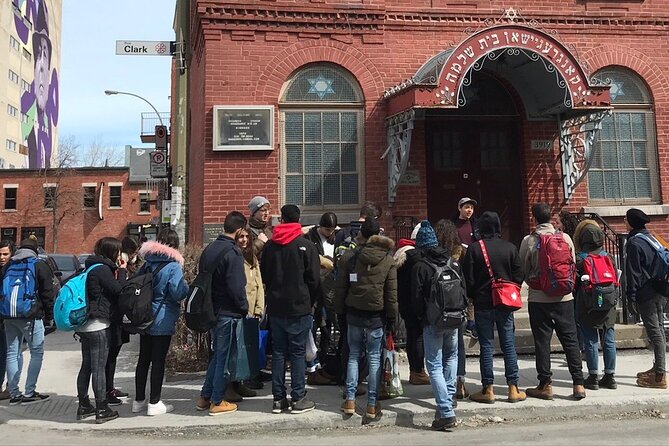
- The walk begins near 3961 Saint-Laurent Boulevard, at the intersection with Napoleon, and finishes outside 3919 Clark Street at Bagg.
- The tour focuses on Jewish Montreal in the Plateau and Mile End, including immigration, work, religion, education, medicine, and local industry.
- Guides bring different strengths, with Shannon praised for emotional insight and storytelling, and Emily, Pauline, and Tani noted for clear, friendly presentations.
- A short rest break helps break up the two-hour walk, though you still need a moderate level of fitness.
- The group can include up to 20 people, large enough for energy but still workable for questions.
- The tour costs $24.03 per person, a reasonable price for a guided introduction to a part of Montreal many visitors miss.
A Jewish Montreal story written into city streets
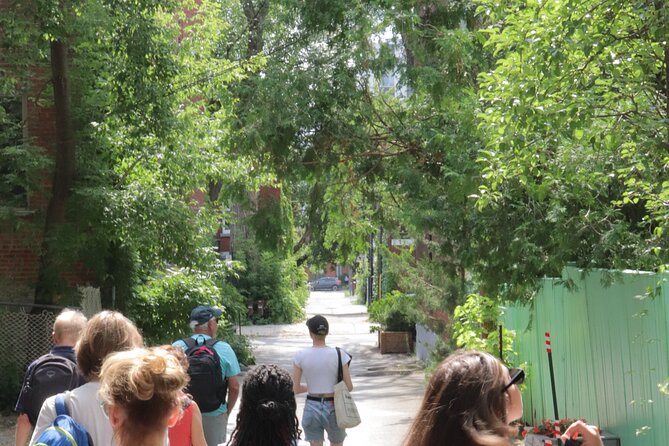
This is not a museum tour that keeps you indoors. It is a neighborhood walk through the Plateau and Mile End, where the city itself becomes the setting for the story.
The tour looks at the arrival of Jews from Eastern Europe and the realities they faced after settling in Montreal. You learn how people built lives through shops, tailoring, religious institutions, schools, medical care, and community work. The emphasis is not only on hardship. The tour also shows the effort, creativity, and civic contribution that helped shape Montreal.
That balance matters. You are not simply shown an old building and told its date. You are encouraged to connect a location with the people who used it and the pressures they faced. A former tailor shop, for example, can help explain how work and family life were tied together in the neighborhood.
The experience also makes an important point about urban change. Many major Jewish institutions and businesses have moved elsewhere, and some earlier buildings no longer exist. The present-day streets can look ordinary, even anonymous, beside the stories attached to them. That gap between what you see and what once stood there is both the tour’s challenge and one of its strengths.
More history-led days in Montreal:
- Montreal History Guided Sightseeing Cruise
★ 3.5 · 363 reviews - Rabbis, Writers and Radicals: Montreal Jewish History Walking Tour
★ 4.5 · 52 reviews - In the Shadow of the Mountain: Montreal Jewish History Walking Tour
★ 4.5 · 33 reviews
Starting near Saint-Laurent Boulevard
The tour begins outside 3961 Boul. Saint-Laurent at Napoleon. The booking information also gives 4129 Saint-Laurent Boulevard as the general starting point, so check the exact meeting instructions on your ticket before setting out. One past booking problem involved an incorrect meeting location, and another participant had to call the museum to find the group.
That is a practical detail worth taking seriously. The tour does not begin at the Museum of Jewish Montreal building. Arrive a little early, confirm the street number and intersection, and keep the provider’s contact details handy. The walk finishes in a different place, outside 3919 Rue Clark at the corner of Clark and Bagg.
This point-to-point format works well if you plan to continue exploring Mile End or the Plateau afterward. It is less convenient if you expect to return to your starting point immediately. You will need to organize your next stop from the ending location rather than from the museum.
The tour is offered in English and comes with a local guide. It is capped at 20 people, which should leave room for questions without making the walk feel entirely private. You are near public transportation, but hotel pickup and drop-off are not included.
The Museum of Jewish Montreal connection
The first listed stop is the Museum of Jewish Montreal, with a short ten-minute entry in the tour plan. In practice, the walking tour begins and ends elsewhere around the Plateau and Mile End, not at the museum’s exhibition building.
The museum’s exhibitions are located at 5220 Saint-Laurent Boulevard. The information provided says the exhibitions are open Thursday through Sunday, with Monday openings beginning in late May 2024. Hours can change, so check the museum’s current website if you want to add a museum visit.
This distinction is useful when planning your day. The walking tour gives you an outdoor introduction to the neighborhood and its people. The museum can then provide an indoor follow-up, but you should treat it as a separate stop and not assume museum admission is part of the walking tour.
The tour itself includes the local guide. Museum entry is listed as free for the brief stop, but the main value here is the guided interpretation rather than time spent inside a gallery.
Following immigration, work, and community life
The heart of the walk is the account of Jewish immigration to Montreal. You learn about the movement of Eastern European Jews to the city and the effort required to build a community in a new country.
The subjects reach beyond religion. The tour discusses education, medical care, industry, and local institutions, along with the people who helped develop them. It also places Yiddish culture within the streets of Montreal. That wider view keeps the experience from becoming a narrow tour of synagogues or religious landmarks.
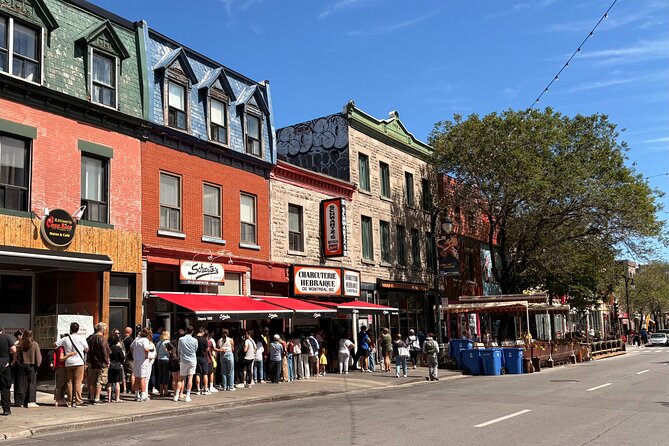
A useful feature is the attention to ordinary work. One stop includes H. Fischer & Fils and its tailor shop, a detail that makes the past easier to picture. A shopfront can say a great deal about clothing trades, family businesses, and the kinds of services a growing neighborhood needed.
You will also hear about how present buildings relate to earlier uses. Some structures may look like ordinary commercial or residential properties today, yet their connection to Jewish Montreal gives them a different meaning. The guide’s job is to make those links clear without burying you under names and dates.
More walking tours in Montreal:
- The Original Old Montréal Walking Tour by Guidatour
★ 4.5 · 2,217 reviews - Old Montreal Small-Group Walking Tour | Max 10 | by MTL Detours
★ 5.0 · 2,088 reviews - Montréal: The Original Old Montréal Walking Tour
★ 4.8 · 911 reviews - Old Montreal: Traditional Ghost Walk of the Haunted City
★ 4.7 · 746 reviews
Why the vanished buildings still matter
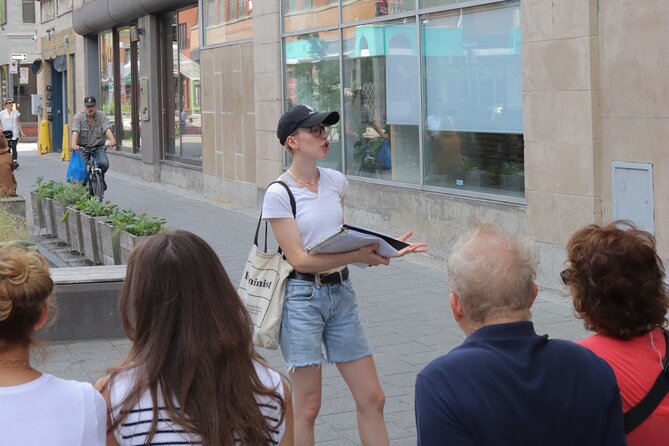
You should come prepared for a tour of traces, not a preserved historic district. Some original buildings and much of the earlier Jewish neighborhood are gone. Several important Jewish sites and institutions have moved to other parts of Montreal.
That can feel disappointing if you expect a long line of intact landmarks. One section of the walk may appear fairly nondescript until the guide explains what once happened there. The tour asks you to use your imagination, with the help of stories and context, rather than relying on grand architecture.
I see this as a fair trade. A preserved district can show you façades, but a changing neighborhood can show you how communities shift. The guide helps you understand why the original center changed and how the Jewish presence remains part of Montreal’s wider story.
The strongest guides seem to handle this carefully. Shannon is praised for bringing early twentieth-century life into focus and for explaining the emotional weight of difficult circumstances. She is also described as attentive to the group and willing to admit when she does not have a definite answer. That last quality matters. It makes the tour feel more trustworthy than a performance built around pretending to know everything.
Two hours with a short rest break
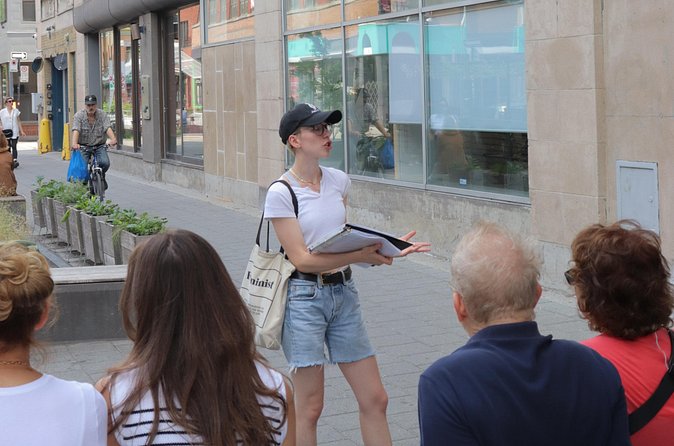
The route takes about two hours. That is long enough to establish a meaningful story but short enough to fit into a full day of sightseeing.
There is a lot of walking, so wear comfortable shoes and plan for an outdoor activity. The stated requirement is a moderate level of physical fitness. The guide includes a short break in the middle, which helps, but this is not a seated talk with occasional steps outside.
The pacing appears to be one of the tour’s strongest practical features. Shannon is praised for making the two hours feel manageable, while another guide is described as organized, flexible, and willing to leave space for discussion. A group of 20 may sound large, but the format allows time for questions.
Morning and afternoon departures give you useful flexibility. An afternoon tour can fit after a morning museum visit or market stop, while a morning walk leaves the rest of your day open for Mile End, the Plateau, or the museum’s exhibitions. The exact departure times are not provided here, so check them when booking.
Families can take this tour, and one booking included two teenagers. Younger children may enjoy the street setting and human stories, but the subject requires sustained listening. Your family will get more from it if everyone can manage a two-hour historical walk.
The guides make the difference
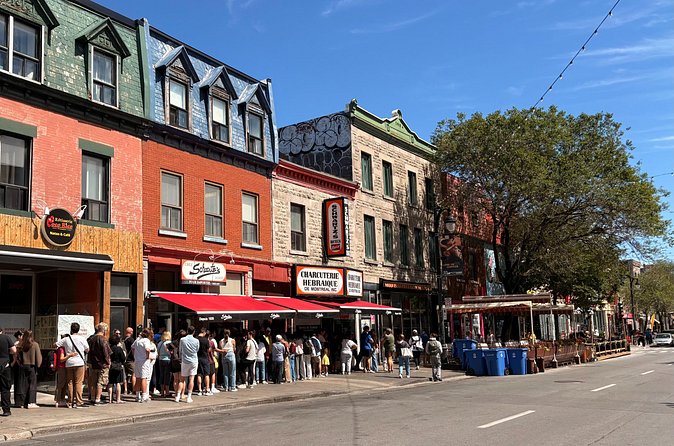
The subject is strong, but the guide determines how much you take away. Shannon receives especially warm praise for combining factual command with emotional intelligence. She is described as personable, organized, funny, and able to make the early twentieth-century Jewish experience feel immediate without overwhelming the group.
Emily is praised for explaining how present buildings connect to the past. Pauline is noted for a lively, clear account of Jewish life in the neighborhood and for her willingness to answer questions honestly. Tani is described as prepared and effective with a family group that included teenagers.
You may get any of these guides, and each brings a slightly different style. The common thread is an emphasis on explanation rather than spectacle. You are there to understand Montreal through its Jewish past, not to collect a checklist of photo stops.
The guides also appear comfortable with questions. That is important on a history tour, where visitors may have family connections, religious questions, or curiosity about how the community changed after the war. One clear criticism is a desire for more discussion of postwar Jewish Montreal. If that period is your main interest, ask about it during the walk, since the tour leans more heavily toward earlier immigration and community formation.
Is $24.03 good value?
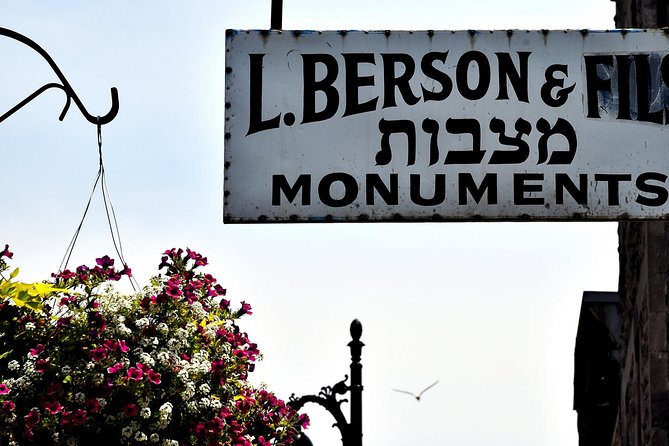
At $24.03 per person, this is an affordable guided walk. The price is especially fair if you value interpretation, because much of the neighborhood’s story is not obvious from the street.
You are paying for roughly two hours with a local guide, not for a large attraction ticket or a meal. The tour’s value comes from the connections you would probably miss on your own: why a building matters, how a trade shaped the area, and where Jewish institutions once fit into Montreal life.
The cost also makes this a low-risk addition to a Montreal itinerary. If you already plan to explore Saint-Laurent Boulevard and the Plateau, the tour gives that wandering a clear purpose. If you have only a short time in the city, it offers a focused introduction to one part of Montreal’s past.
The value is lower for anyone seeking grand surviving landmarks or a detailed account of postwar Jewish life. You may find the walk too centered on one former neighborhood, especially if you prefer architecture over social history. Still, at this price, the guide’s context does much of the work.
Who should book this walk
I would recommend it to anyone interested in immigration, urban change, Jewish culture, Montreal neighborhoods, or the people behind the city’s institutions. It is a particularly good choice if you want history connected to ordinary streets rather than confined to a formal museum.
Families with older children and teenagers can use it as a way to make Montreal’s past more concrete. Couples and solo visitors should also find the two-hour format easy to fit into a sightseeing day. The small maximum group size and discussion-friendly pacing help if you like asking questions.
You may want to skip it if walking is difficult, if you want a tour focused mainly on surviving buildings, or if your priority is the period after the Second World War. The physical requirement is moderate, and the route includes enough walking that comfortable footwear is essential.
The 96 percent recommendation rate and 4.8 rating from 166 ratings suggest dependable satisfaction, but the one operational failure and the meeting-point confusion show why you should verify the location carefully. The provider offered a full refund for the no-show case and explained that an external booking error caused it. That response is reassuring, but prevention is better: check the ticket details before leaving.
A good companion to the walk
If the museum’s exhibitions are open during your visit, consider adding them separately. The walking tour and museum serve different purposes. The walk gives you streets, former businesses, and a guide’s narrative. The museum offers an indoor setting for further material at 5220 Saint-Laurent Boulevard.
Do not assume the two locations are adjacent or that the tour starts at the exhibition building. The listed meeting and ending points are around the Plateau and Mile End, while the museum building is elsewhere on Saint-Laurent Boulevard.
You can also use the tour as a first look at the neighborhood before returning to places that caught your interest. Since the route ends near Clark and Bagg, you can continue exploring from there, though no return transport or hotel transfer is included.
Should you book Making Their Mark?
Book this tour if you want Montreal’s Jewish past explained through immigration, work, culture, and the changing city around you. The best part is the guide’s ability to make absent buildings and ordinary streets meaningful, especially when Shannon, Emily, Pauline, or Tani leads the walk.
Go in expecting a thoughtful neighborhood history lesson, not a preserved Jewish quarter. You will walk for two hours, use your imagination, and hear more about early community life than later postwar developments. At $24.03, that is a sensible price for an engaging introduction, provided you confirm the exact meeting point and can manage the walking.
FAQ
Where does the tour begin?
The tour begins outside 3961 Boul. Saint-Laurent at the intersection with Napoleon. The information also lists 4129 Saint-Laurent Boulevard as the start, so use the exact meeting instructions on your ticket.
Where does the tour end?
The tour ends outside 3919 Rue Clark in Montreal, at the intersection of Clark and Bagg.
Does the tour begin at the Museum of Jewish Montreal?
No. The walking tour begins and ends at different locations around the Plateau and Mile End, not at the museum’s exhibition building.
How long does the experience last?
The walking tour lasts approximately two hours and includes a short break in the middle.
What language is the tour offered in?
The tour is offered in English.
How much does the tour cost?
The listed price is $24.03 per person.
Is the tour suitable for families?
Yes. It is described as family-friendly, and families with teenagers have taken part.
How large is the group?
The maximum group size is 20 people.
Can I cancel for a refund?
Yes. You can cancel at least 24 hours before the local start time for a full refund. Cancellations or changes made less than 24 hours before the experience are not accepted for a refund.
Just added around Montreal
- Winter Express: Old Montreal Highlights Walking Tour★ 5.0 · 119 reviews
- Under the Surface of Montreal’s Chinatown: Guided Food Walking Tour★ 5.0 · 23 reviews
- Full Day Family Bike Rental★ 5.0 · 17 reviews
- Montreal Premium Driving Tour with River Cruise and Notre Dame★ 4.5 · 164 reviews
- Immersive Virtual Reality Game Activity★ 5.0 · 19 reviews
- Montréal Downtown and Underground City Private Walking Tour★ 5.0 · 47 reviews
- Day at Mont-Tremblant National Park★ 4.0 · 5 reviews
- In the Shadow of the Mountain: Montreal Jewish History Walking Tour★ 4.5 · 33 reviews
Montreal Tours, compared.


Montreal Mile End Authentic Food Tour with 7 Delicacies Tastings
Read our review →
Quebec City and Montmorency Falls Day Trip from Montreal
Read our review →
The Original Old Montréal Walking Tour by Guidatour
Read our review →
Old Montreal Small-Group Walking Tour | Max 10 | by MTL Detours
Read our review →
Montreal City Sightseeing Tour with Live Commentary
Read our review →
Browse the lists this tour appears in