
Review · KINGSTON
Ghost Tour of Queen’s University
Kingston’s Queen’s University campus gives this ghost walk a fine setting: limestone buildings, old churches, former hospitals, and student spaces all gather within a compact historic area. The stories reach from the 1830s to the modern university, mixing documented events with local ghost lore.
I like the route’s variety. You get more than one haunted building, including Summerhill’s grim medical past and the Agnes Etherington Art Centre, plus personal tales tied to Charles Sangster, Douglas Mill Jemmett, and Alfie Pierce. I also like the small group limit of 20, which should make it easier to hear the guide after dark.
The main thing to consider is that this is an outdoor evening walk, not a theatrical indoor attraction. It runs for about 75 minutes, starts at 8 pm, and needs good weather, so bring sensible shoes and do not expect every story to produce a scare.
Key points about Kingston’s Queen’s ghost walk
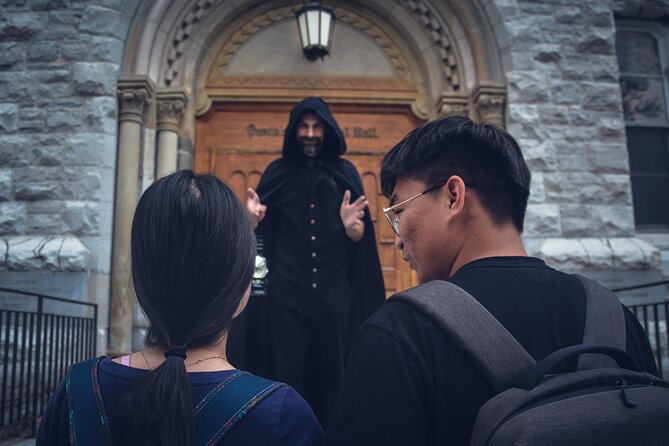
- Historic courthouse meeting point: Begin at the Kingston courthouse, a Greek Revival National Historic Site built in the late 1850s.
- Ten story locations: The route connects Queen’s University buildings with Chalmers United Church, hospitals, an art museum, and other old Kingston sites.
- Personal ghost stories: Listen for the unsettling stories of poet Charles Sangster, engineer Douglas Mill Jemmett, and Alfie Pierce.
- Useful for families: The guide can present the stories in a way that works for children, though some medical and death-related tales may be too grim for very young listeners.
- Small evening group: A maximum of 20 people keeps the walk more personal than a large street tour.
- Simple, flexible booking: Your mobile ticket is confirmed at booking, and you can cancel free of charge up to 24 hours before the 8 pm start.
Why Queen’s University makes a good haunted setting
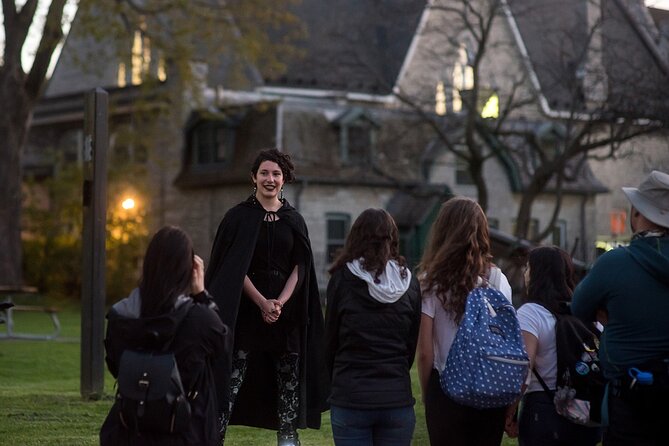
Queen’s University began in the 1840s, and its campus brings together several periods of Kingston’s past. The older buildings are not just attractive backdrops. Their former uses give the guide plenty to work with: political offices, medical training rooms, student buildings, churches, and private homes.
That variety matters. A ghost walk can grow repetitive when every stop is just another old doorway. Here, each place has a different angle. One story may focus on a person connected with the university, another on an unusual building use, and another on a tragedy tied to Kingston’s broader civic life.
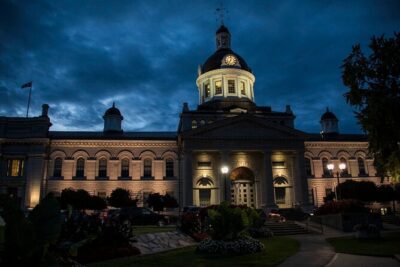
The tour begins at the Kingston courthouse on Court Street. Built in the late 1850s in Greek Revival style, the limestone structure was designated a National Historic Site of Canada in 1980. It is a fitting starting point, since it gives you the grand civic side of Kingston before the route turns toward campus stories.
I would arrive a few minutes early. The stated meeting point is 5 Court Street, Kingston, Ontario, and the tour returns there at the end. Since the walk begins at 8 pm, daylight may be fading or gone depending on the season, so knowing the starting location in advance saves a little last-minute wandering.
A few more Kingston half-days to weigh up
- Kingston: Heart of the Thousand Islands Riverboat Cruise
★ 4.2 · 771 reviews - Kingston: Lunch Cruise of Thousand Islands
★ 4.5 · 212 reviews - Kingston: Sunset Dinner Cruise
★ 4.5 · 197 reviews
The courthouse and Chalmers United Church
The courthouse is the first setting for a ghost story. You can expect the guide to use the building’s formal stone exterior and public role as the backdrop, rather than treating it as a quick check-in point.
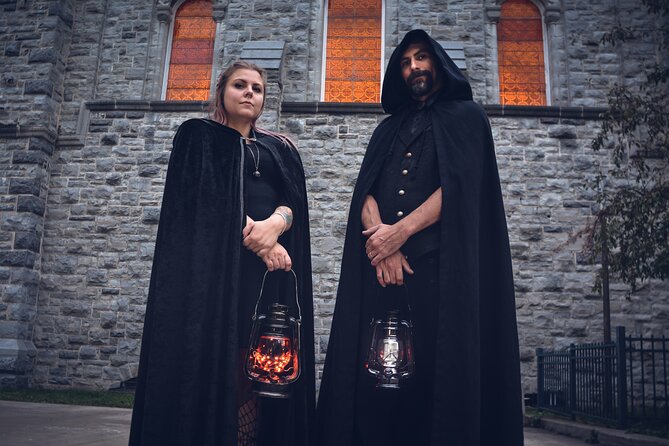
Next comes Chalmers United Church, a Gothic Revival building completed in 1890. Its pointed architectural style gives the stop a different mood from the courthouse, and the tour includes a ghost story connected with this heritage building.
The church stop is a good reminder that Kingston’s ghost tales are not limited to Queen’s University. The route links the university to the wider city, helping you see how campus life and Kingston’s civic, religious, and medical past overlap.
The supplied information does not say that you enter the courthouse or church. Plan for a walking experience around historic exteriors and public areas, and do not assume that the tour includes indoor access. That is common sense for an evening route, but it is worth knowing if you are hoping to tour the buildings themselves.
Fleming Hall and the story of Douglas Mill Jemmett
Much of the walk takes place around Queen’s campus. Fleming Hall is one of the more useful stops for understanding how the university remembers its own past.
The original building honours Sir Sandford Fleming, a former chancellor of Queen’s. Its other three wings honour people connected with Electrical Engineering, which occupied Fleming Hall until 1989. The Jemmett Wing is tied to Douglas Mill Jemmett, whose story supplies one of the tour’s more chilling moments.
This is the kind of stop I find more effective than a generic haunted-house tale. The building has names, departments, and institutional changes that you can see reflected in the campus itself. The ghost story gains weight from a real connection to university life.
You may want to pay attention to the names on the buildings as the guide speaks. Even if you forget the details later, you will come away with a better sense of how Queen’s has grown and how its buildings carry older layers of university memory.
Four Directions and Charles Sangster’s tragic story
Four Directions has supported the success of Indigenous students since 1996 and moved into its current home in 2000. The house itself dates to 1886 and once had several notable residents, including Canadian poet Charles Sangster.
The tour shares Sangster’s tragic story here. This stop shifts the focus from institutional history to an individual life, giving the evening a more personal edge.
It is also a useful pause from the better-known Queen’s buildings. You are not simply following a campus tour in the usual sense. The walk brings in a historic residence and a person connected to Canadian literature, then frames the site through a darker story.
Because the tour is only about 75 minutes, the guide cannot provide a full biography at every stop. Think of each location as a sharply chosen chapter. If a particular figure catches your interest, make a note of the name and explore more later.
Same base, a completely different sort of day:
- Kingston: Ghosts and Mysteries Trolley Tour
★ 4.4 · 158 reviews - Kingston: Haunted Night Walking Tour
★ 4.6 · 144 reviews - Kingston: Brunch Cruise of Thousand Islands
★ 4.3 · 132 reviews - Kingston: Waterfront Discovery Cruise
★ 4.2 · 129 reviews
Summerhill’s medical past turns grim
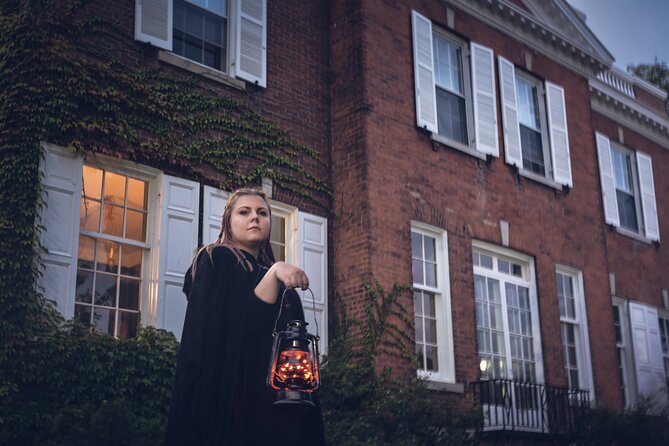
Summerhill may be the most layered stop on the route. Constructed in 1839, it was first intended as the country villa of Archdeacon George O’Kill Stuart.
When Kingston served as Canada’s capital, Summerhill became a boarding house for members of the Legislative Assembly. Queen’s bought the building in 1854, and it served for many years as the university’s only building. Later, it housed the medical school.
That last chapter is where the story becomes macabre. The medical school used Summerhill for practices that give the guide some of the evening’s grimmer material.
I like this stop because it shows how a building can change meaning over time. Summerhill began as a private home, took on a political role, became the centre of an emerging university, and later became associated with medical training. Each use adds another layer to the ghost story.
This is also the point where families should use their judgment. The tour can be done with children, and one piece of feedback specifically found it suitable for kids, but medical tales involving death and anatomy may unsettle younger children. If your child is sensitive to dark stories, ask yourself if the subject matter sounds right before booking.
Kingston’s hospitals and the empty building problem
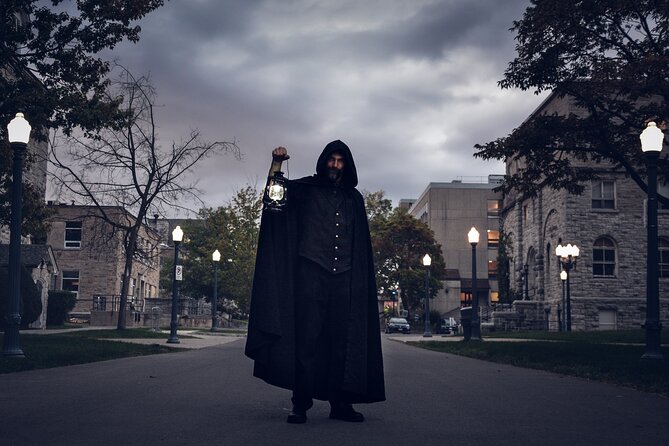
Kingston’s hospitals are linked to Queen’s medical education, and this section of the walk brings the city’s medical past beyond Summerhill. Kingston General Hospital was built in 1835, but once the original building was finished, the budget had no money left for furnishings. The hospital sat empty for three years.
That detail is striking because it is so ordinary and so strange. A large hospital existed, but it could not yet function as intended. The building later served several purposes, including a period as Canada’s first temporary parliament building.
The tour shares stories from two Kingston hospitals. You should expect this part to connect medical history with ghost lore, rather than hear only about Queen’s campus buildings.
Hospital stories can be some of the strongest material on a ghost walk, but they can also be the most unsettling. I would not book this section for a very young child simply because the word ghost sounds family-friendly. The guide’s presentation may be suitable for children, but the subject matter includes illness, death, and old medical practices.
The Agnes Etherington Art Centre after dark
The Agnes Etherington Art Centre brings an unexpected note to the route. It is a major art museum on the Queen’s campus, with more than 17,000 works ranging from ancient to contemporary art.
During the day, you might think of this place as a calm cultural stop. At night, the tour presents it as a haunted location. That contrast is part of the appeal. Art museums already encourage you to look closely at objects, rooms, and quiet corners, and a ghost story changes how you imagine the building after closing time.
The museum also gives the route a break from purely academic or medical settings. It represents Queen’s as a place of culture and public programming, not only classrooms and offices.
Do not mistake this stop for an art museum visit. The tour information does not include admission or an indoor museum program, so you should treat the art centre as one location in the evening walk. If you want to visit the collections, plan that separately during opening hours.
Dunning Hall and a newer kind of campus haunt
Dunning Hall is one of the campus’s less familiar haunted sites. Built in 1960, it is newer than most of the buildings on the route and houses Queen’s Department of Economics along with some of the university’s largest lecture halls.
This stop helps the tour avoid the easy assumption that only 19th-century stone buildings can have ghost stories. Dunning Hall is comparatively modern, yet it has its own place in the local supernatural tradition.
I appreciate the change of period here. The route moves from old churches and Victorian residences to a mid-century academic building, making the subject broader than architecture. If every stop were from the 1800s, the evening could feel like a history lesson with the same visual backdrop. Dunning Hall changes the rhythm.
It is also a useful location for people who already know Kingston’s famous older sights. You may have seen the courthouse and Queen’s historic buildings before, but this gives you another way to look at a familiar campus.
The John Deutsch University Centre and Alfie Pierce
The final major story location is the John Deutsch University Centre. Rebuilt in 1947 after the original Students’ Union was destroyed by fire, it is linked to many of the ghostly events attributed to Alfie Pierce.
This gives the tour a strong closing chapter. The building is tied to student life, fire, rebuilding, and a named spirit whose activity is said to centre there. Compared with a general story about an old building, a recurring figure gives the guide a character to return to.
The information does not spell out the exact nature of Alfie Pierce’s story, which is probably best left for the guide to tell in person. You can expect this stop to focus on the reported activity associated with his spirit, not simply the building’s architectural features.
After the final story, the activity ends back at the courthouse. That return is practical. You are not left at a distant campus corner late at night, and you can easily continue into central Kingston from the starting point.
What the $25.31 price gets you
At $25.31 per person, this is priced as a modest evening activity rather than a full historical tour or museum experience. For about 75 minutes, you get a guide, a planned route, and a series of stories tied to specific Kingston buildings.
The value depends on what you want from a ghost walk. If you want actors, costumes, special effects, or access to haunted interiors, this may feel basic. If you want local history delivered with a spooky angle, the price is reasonable, especially since the route covers many locations in one compact outing.
The small maximum of 20 is important. A group that size can still feel social, but it should be easier to stay close to the guide and hear the stories than on a large city walk. The experience is offered in English, and the mobile ticket makes arrival simple.
The tour is booked around 10 days ahead on average. That is not a rule, but it is a useful planning clue. If your Kingston visit falls on a busy weekend or you are set on a particular evening, booking ahead is sensible.
Who should book this evening walk
I would recommend this tour to you if you enjoy local history with a supernatural twist. It suits couples, families with older children, university visitors, and anyone who wants a short activity after dinner rather than a long guided tour.
It is especially useful for first-time visitors who want an introduction to Queen’s University and nearby Kingston landmarks. You will hear about the campus, hospitals, churches, and historic residences without giving up an entire evening.
Families should decide based on temperament, not just age. The tour can work well with children, but the medical stories and tragic personal tales may be intense for some. Older children who enjoy spooky stories are likely to get more from it than very young kids.
You should also choose it if you like named characters and place-specific stories. Charles Sangster, Douglas Mill Jemmett, and Alfie Pierce give the tour a human focus. If you prefer verified political or architectural history only, the ghost-story format may not be your best match.
The walk requires good weather. If poor weather cancels it, you are offered another date or a full refund. The same applies if the minimum number of participants is not met. You can cancel for a full refund up to 24 hours before the start time, but changes or cancellations inside that window are not accepted.
Service animals are allowed, the route is near public transportation, and most people can participate. The available information does not provide a detailed accessibility description, so contact the provider if you need specific information about walking surfaces, seating, or distance.
Should you book the Queen’s ghost tour?
Book it if you want a reasonably priced, English-language evening walk that connects Kingston’s old buildings with memorable ghost stories. The best parts are the range of settings and the named local figures, not elaborate effects.
I would be more cautious if you dislike outdoor walking, need guaranteed indoor access, or want a very frightening theatrical show. The 75-minute length is a strength for most people, but it also means the stories will be selected highlights rather than full biographies.
For most visitors, this is a good way to see Queen’s University after dark and notice details you might otherwise pass without a second thought. Arrive at the courthouse a little early, wear comfortable shoes, check the weather, and book ahead if your schedule is tight.
FAQ
Where does the Ghost Tour of Queen’s University begin?
The tour begins at the Kingston Frontenac County Courthouse, 5 Court Street, Kingston, Ontario, K7L 2N4.
What time does the tour start?
The stated start time is 8:00 pm.
How long does the tour last?
The experience lasts approximately 1 hour and 15 minutes.
Where does the tour finish?
The activity ends back at the courthouse meeting point.
What language is the tour offered in?
The tour is offered in English.
How many people can join the tour?
The maximum group size is 20 travelers.
Can I cancel for a full refund?
Yes. You can cancel at least 24 hours before the experience start time for a full refund. Cancellations or changes made less than 24 hours before the start time are not accepted for a refund.
Just added around Kingston
- Trolley City Tour of Kingston★ 5.0 · 27 reviews
- Kingston Self-Guided Walking Tour & Scavenger hunt (updated)★ 3.5 · 10 reviews
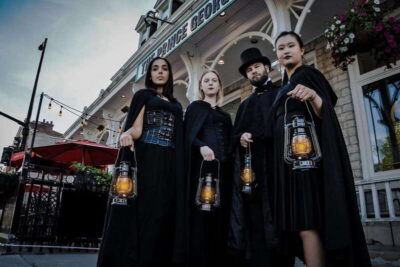
- Orignal Haunted Walk of Kingston 75-Minute Ghost Tour★ 4.5 · 113 reviews
- Heart of the 1000 Islands Sightseeing Cruise★ 4.0 · 80 reviews
- Kingston Bike Tours★ 5.0 · 30 reviews
- Kingston: Waterfront Discovery Cruise★ 4.2 · 129 reviews
- Kingston: Trolley City Tour★ 4.6 · 99 reviews
- Kingston: Hop-On Hop-Off Trolley Tour★ 4.7 · 57 reviews
Kingston Tours, compared.


Orignal Haunted Walk of Kingston 75-Minute Ghost Tour
Read our review →Browse the lists this tour appears in