
Review · HALIFAX
Half-Day Historical Tour of Halifax
Halifax history is not confined to one museum or downtown street. It reaches from Pier 21 and the waterfront to Titanic cemeteries, the Halifax Explosion memorial, Dartmouth, and a small fishing village across the harbour. This tour connects those places in one long, story-filled outing, led by local guide Paul McNeil.
I like the small group size, capped at 10, and the easy hotel or cruise-port pickup. I also like the way Paul uses photos, videos, and a tablet inside the van to explain events that can be hard to picture from a roadside stop.
The main caution is that six hours covers a lot of ground. You’ll spend substantial time riding between sights, and several stops are brief. If you want long museum visits or slow photography sessions, this is not the right format.
Key points to know before booking

- A wide-ranging Halifax history route: Expect Titanic stories, the Halifax Explosion, military sites, immigration, churches, cemeteries, and maritime history.
- Small-group touring: The Ford Transit van carries four to 10 people, making it more personal than a large coach.
- Short walks mixed with driving: This suits anyone who wants to see a lot without walking all day, though the tour is not a fully stationary sightseeing experience.
- Paul’s multimedia approach: A mounted tablet adds photographs, videos, and visual context while you ride.
- Dartmouth and Fisherman’s Cove included: You’ll cross beyond central Halifax for seafood, harbour views, Lake Banook, and a restored fishing village.
- Plan around the clock: The Noon Gun and changing of the guard are time-sensitive, while cruise passengers need to allow time to return to the ship.
A city tour built around disasters, ships, and survival
Halifax can feel cheerful on the surface, with a waterfront boardwalk, breweries, gardens, and colourful buildings. Its past is more somber. This route gives serious attention to the Titanic disaster of 1912 and the Halifax Explosion of 1917, while also showing how the city grew as a naval base, immigration gateway, political centre, and working port.
I appreciate that the tour does not treat these events as quick photo opportunities. At the cemeteries and memorial sites, Paul explains individual stories and the human cost behind the numbers. His presentation style is detailed and sometimes intense, so you should come ready to listen rather than simply hop out for pictures.
You also get a broad look at ordinary Halifax life. The route passes the Halifax Seaport Farmers’ Market, historic warehouses, churches, universities, public buildings, parks, and the fishing village of Fisherman’s Cove. That mix gives you a better sense of the city than a route focused only on famous monuments.
More history-led days in Halifax:
- Peggy’s Cove & Halifax Historic Tour
★ 4.5 · 375 reviews - Historic Halifax by Foot
★ 4.5 · 191 reviews - Peggy’s Cove/Mahone Bay & Lunenburg UNESCO HERITAGE SITE.
★ 4.5 · 139 reviews
From Pier 21 to the Halifax waterfront
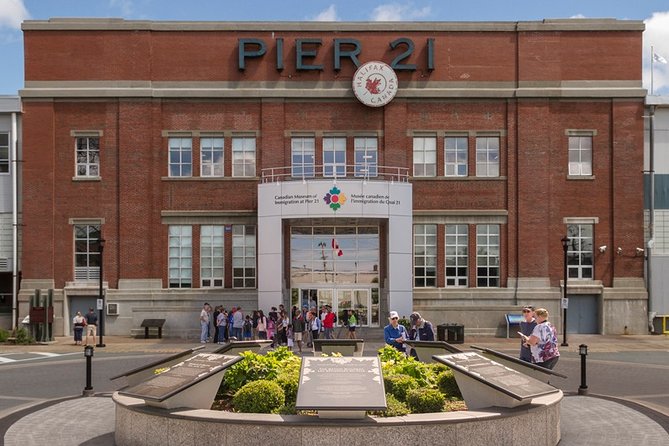
The tour begins at Pier 22 on Marginal Road, with pickup available from listed downtown hotels and the port. Pier 21 is introduced as the Gateway to Canada, a fitting place to begin a tour that pays attention to immigration and separation.
The Halifax Seaport Farmers’ Market follows. Founded by Royal Proclamation in 1750, it has occupied several sites before moving to the seaport in 2010. It is described as North America’s longest continuously running market and now hosts more than 250 vendors.
You should think of this as an explained stop rather than a dedicated market visit. Six hours is not enough for a full browse, meal, and shopping session here, but the market helps place Halifax in its early colonial and trading context.
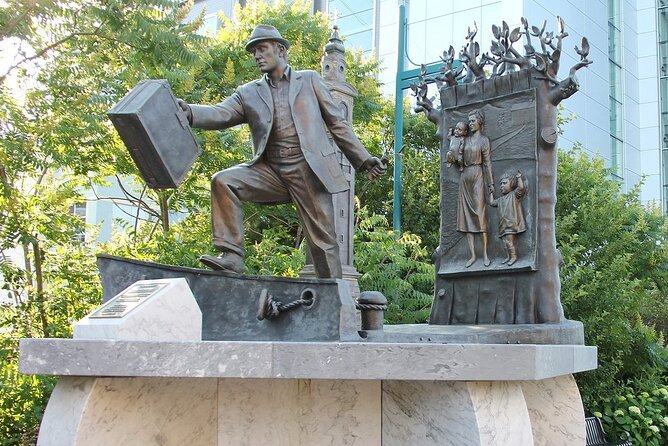
Nearby, you’ll hear about Armando Barbon’s immigration memorial. The artwork shows Armando stepping onto a ship, with his wife Yole and their children represented in a family tree. His family followed five months later. It is a small but affecting reminder that immigration history is also a story of waiting, uncertainty, and hope.
The waterfront portion includes the Cunard connection. Sir Samuel Cunard, born in Halifax, founded the Cunard Line after growing up as the son of a carpenter and timber merchant who had fled the American Revolution. The boardwalk then opens up views of Halifax Harbour, described as the world’s second-largest natural harbour.
Harbour defence and the working waterfront
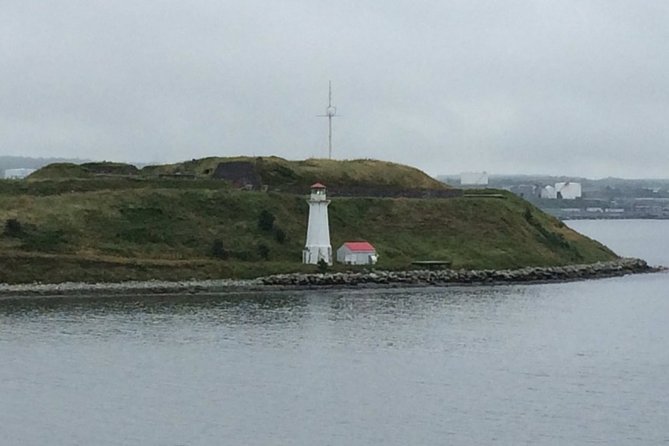
Georges Island sits in the middle of Halifax Harbour and once formed a key part of the British naval defence system. You’ll hear about Fort Charlotte, seaward batteries, underground passages, and one of Canada’s first fully automated lighthouses.
The island also has a painful connection to the deportation of the Acadians between 1755 and 1763. Large numbers of Acadians were held there during Le Grand Dérangement. Stories of tunnels and underground passages later fed local folklore, giving the island both military weight and an air of mystery.
The route continues past Alexander Keith’s Nova Scotia Brewery. Keith opened the brewery nearly 200 years ago, and the site remains a working brewery and visitor attraction. The tour focuses on the founder and the brewing tradition rather than including a tasting, so alcohol is not part of the price.
You’ll also see HMCS Sackville, the only surviving Allied corvette from the Second World War still serving as Canada’s Naval Memorial. It is one of 123 corvettes built in Canada and a National Historic Site.
If you have extra time before or after the tour, the Maritime Museum of the Atlantic is the natural follow-up. Its exhibits cover sailing ships, steam, wartime convoys, the Titanic, and the Halifax Explosion. The museum is recommended as a separate visit, not included as a stop with admission.
Downtown Halifax, from old warehouses to historic churches

Historic Properties occupies three blocks of waterfront warehouses dating from the late 1700s and early 1800s. Its Victorian-Italianate façades make it one of the clearest places to see Halifax’s commercial past in built form.
The tour then threads through several downtown landmarks. Saint George’s Round Church, built in 1800, was designed in the Palladian style to serve a growing congregation. Its unusual circular form makes it easy to recognize, but the story attached to the church is sad.
St. Paul’s Anglican Church dates to 1749 and was the first Anglican cathedral built outside England. It is also Halifax’s oldest building. Inside are reminders of the 1917 explosion, including the famous Ghost Window and a piece of wood lodged in an interior wall.
You’ll pass Halifax City Hall, built between 1887 and 1890, and Province House, which opened in 1819. Province House is Canada’s oldest legislative building and home to the country’s first elected House of Assembly. Government House, the oldest official residence in Canada, remains the working residence of Nova Scotia’s lieutenant governor.
Other downtown sights include St. Mary’s Cathedral Basilica, the Halifax Court House, and a modern building whose shape is said to resemble a stack of books. These drive-by explanations add architectural variety, though they are not substitutes for entering each site.
The Old Burying Ground gives you a quieter pause. More than 1,200 headstones and footstones remain inside this early cemetery, now a green, walled space in the centre of the city. You’ll also hear about Maud Lewis, Nova Scotia’s famous folk artist, adding a cultural note to the political and military stories.
A few more Halifax half-days to weigh up
- Half-Day Small-Group Tour of Nova Scotia’s South Shore
★ 5.0 · 119 reviews - Half-Day Small-Group Tour of Annapolis Valley
★ 5.0 · 35 reviews - Vancouver Half-Day Whale Watching Adventure with Free Photos
★ 5.0 · 5,000 reviews - Half-Day Trip to Montmorency Falls and Ste-Anne-de-Beaupré from Quebec city
★ 4.0 · 2,718 reviews
Cemeteries that tell the Titanic story
The Titanic section is one of the tour’s strongest features. Halifax received many victims from the disaster because of its location and maritime connections, and the city’s cemeteries preserve that story in a direct, personal way.
At Camp Hill Cemetery, you’ll have about 10 minutes to see a burial ground dating to the 1750s. Notable people buried there include Viola Desmond, Alexander Keith, Joseph Howe, Titanic survivor Hilda Mary Slayter, and John Taylor Wood, a Confederate naval officer related to American president Zachary Taylor and Confederate president Jefferson Davis.
Mount Olivet Cemetery is known here as the Forgotten Titanic Cemetery. Nineteen Roman Catholic Titanic victims are buried there. You’ll also hear about Margaret Rice, the Halifax Explosion’s miracle child Ashpan Annie, and Vincent Coleman, remembered for his actions during the explosion.
Fairview Lawn Cemetery contains the largest Titanic memorial section on the route, with 121 victims buried there. The stories of J. Dawson, Sidney Leslie Goodwin, and others make the stop more meaningful than a simple count of graves. The cemetery also contains unidentified victims of the Halifax Explosion.
All Saints Cathedral adds another Titanic connection. It was the site of the first Halifax funeral for William Henry Harrison, Bruce Ismay’s private secretary. These stops are brief, but Paul’s visual material helps fill in what a headstone alone cannot explain.
The Halifax Explosion and the Mont Blanc anchor

The Halifax Explosion section is the emotional centre of the tour. On December 6, 1917, the munitions ship SS Mont Blanc exploded in the harbour, killing roughly 1,900 to 2,000 people, injuring about 9,000, and leaving 25,000 homeless.
At the Mont Blanc Anchor Site, you’ll see a 1,140-pound anchor shaft hurled about 2.3 miles by the blast. Another cannon was thrown nearly three miles to Albro Lake in Dartmouth. These physical objects make the scale of the explosion easier to grasp.
Fort Needham overlooks the area destroyed by the blast. The Halifax Explosion Memorial Bell Tower honours those who died, suffered injury, lost homes, or rebuilt their lives afterward. The original bells came from a church formed by survivors, including Barbara Orr, who lost her entire family.
The tour also explains the Hydrostone district. After wood-frame buildings collapsed onto stoves and furnaces, planners sought safer construction. Concrete blocks finished with crushed granite were made in Eastern Passage and carried across the harbour by barge. The resulting neighbourhood is one of the most visible reminders of Halifax’s rebuilding.
Expect about 20 minutes at the memorial. That is enough for the main story and the view, but not a full exploration of the surrounding area.
Gardens, military ceremony, and the Noon Gun
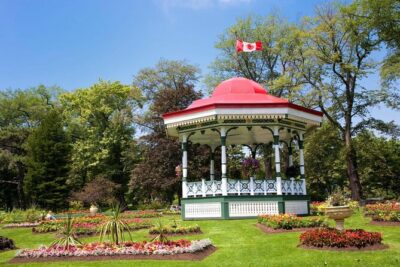
The 17-acre Halifax Public Gardens offer the route’s gentlest stop. This Victorian garden has ornamental gates, iron fencing, flowers, trees, statues, fountains, and exotic and semi-tropical plants. You get about 30 minutes here, enough for a pleasant walk and a reset after the cemetery and explosion material.
At Halifax Citadel National Historic Site, timing matters. The tour aims to reach the fort for the Noon Gun at noon sharp and the changing of the guard by the 78th Highlanders. The present Citadel, completed in 1856, is the fourth fort built on Citadel Hill and is formally called Fort George.
Admission to the Citadel is not included. The scheduled stop is only about 15 minutes, so you see the ceremony and hear the story rather than tour every rampart, room, and exhibit. If the fort is your main interest, plan a separate visit.
The Old Town Clock, installed through the efforts of Prince Edward, Duke of Kent, recalls a practical military problem: local soldiers were not keeping time well. The turret clock was meant to improve punctuality. You’ll have about 15 minutes here.
Point Pleasant Park adds wooded trails, coastal areas, and old fortification ruins at the southern tip of the peninsula. Halifax leases the 75-hectare park from the British government for one shilling a year under a 999-year lease. It is mostly viewed as part of the driving route, so do not expect to walk its full 39 kilometres of trails.
Across the harbour to Dartmouth and Fisherman’s Cove
The Dartmouth portion widens the tour beyond Halifax’s central sights. You’ll pass Dalhousie University, founded in 1818 as a non-denominational college, and the University of King’s College, established in 1789 and recognized as Canada’s oldest chartered university.
Sir Sandford Fleming Park, known as The Dingle, was donated to Halifax in 1908 by Fleming, the creator of standard time zones. The Dingle Tower commemorates 150 years of representative government. The stop lasts about 10 minutes.
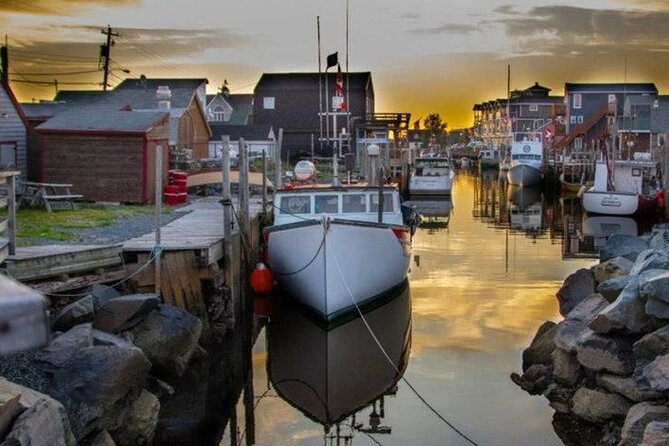
Lake Banook is another Dartmouth landmark. It is home to canoe, kayak, rowing, and dragon boat clubs, and it has a claim to being the birthplace of ice hockey. The route then reaches Fisherman’s Cove, a restored 200-year-old working fishing village with colourful buildings and plenty of photo opportunities.
You’ll have roughly 30 minutes in Fisherman’s Cove. That is enough to walk around, take pictures, and enjoy the setting, but not enough for a leisurely half-day there.
An optional seafood lunch at Evan’s Seafood takes about 30 minutes. Food orders are phoned ahead, which helps keep the stop moving. Lunch is not included, and neither are drinks or gratuities. One important practical point: the lunch menu may not suit every taste, so consider this a convenient local break rather than a central reason to book the tour.
Comfort, timing, and value at $131.43
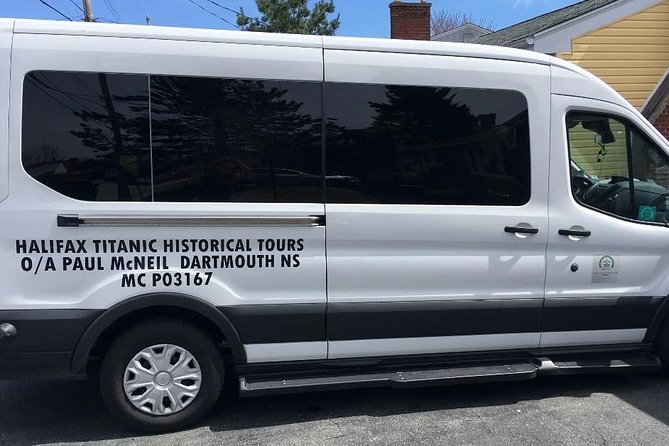
The price is $131.43 per person. For that, you get about six hours, an air-conditioned Ford Transit 350 XLT high-roof van, bottled water, onboard WiFi, hotel or port pickup, and a guide who handles the driving and route planning.
I consider that fair value if you want broad coverage and live interpretation. A private car service would cost more, while a large coach may offer less personal attention. The small group also matters when you need help getting in and out or want to ask a quick question.
The tradeoff is pace. The route contains more sights than any six-hour tour can fully explore. You will ride between many stops, and the short visits are designed to give you the story and the setting, not a complete site visit.
Seating goes to the first people confirmed, so book early if you have a strong preference. The tour requires at least four people and accepts no more than 10. It is offered in English.
For mobility concerns, the van format can work well because there are only a handful of short walks. Most people can participate, and service animals are allowed. Still, you should expect to get out at cemeteries, gardens, the Citadel area, Fisherman’s Cove, and memorials.
Cruise passengers need extra care with timing. The tour normally returns to the meeting point, but a short port call can force the route to be shortened. Confirm your required return time before departure. The meeting point at Pier 22 has secure all-day parking for $10 CAD if you drive.
Free cancellation is available up to 24 hours before departure. Within 24 hours, the price is not refunded. Poor weather or failure to reach the minimum group size can lead to a new date, another experience, or a full refund.
Who should book this Halifax tour?
I would choose this tour if you want the big picture quickly, especially on a first visit. It suits history fans, cruise passengers with a full day in port, families, and anyone who would rather ride between distant sights than manage several taxis or buses.
It is also a good fit if Titanic and Halifax Explosion history matter to you. The cemeteries, anchor, cannon, and memorial bell tower give those subjects a human scale that a general city drive often misses.
I would hesitate if your ideal day means lingering in one museum, spending hours inside the Citadel, or taking many carefully composed photographs. The itinerary is ambitious, and Paul’s detailed commentary means you spend much of the ride listening.
The tour earns its strong reputation for Paul’s preparation, personal delivery, route knowledge, and use of visual material. Just set your expectations correctly: this is a fast-moving historical overview with selected short walks, not a relaxed walking tour.
Should you book the Half-Day Historical Tour of Halifax?
Book it if you want to see Halifax, Dartmouth, Fisherman’s Cove, Titanic cemeteries, the Halifax Explosion sites, and the Citadel in one organized day. At $131.43, the combination of transport, small-group size, and detailed guiding makes sense for a first visit.
Skip it if you want a slow waterfront day or a museum-heavy schedule. For most people with limited time, though, this is an efficient and unusually wide-ranging introduction to Halifax’s difficult, fascinating past.
FAQ
How long is the Halifax historical tour?
The tour lasts approximately six hours.
What is the price per person?
The price is $131.43 per person.
What language is the tour offered in?
The tour is offered in English.
How many people can join the tour?
The tour requires a minimum of four participants and has a maximum of 10 travelers.
Is pickup available from hotels?
Yes. Pickup is available from listed downtown hotels and from the cruise port.
Where is the meeting point?
The meeting point is Pier 22 parking lot at 1041 Marginal Road, Halifax, Nova Scotia.
Is parking available at the meeting point?
Yes. Guests driving to Pier 22 can park all day for $10 CAD. The parking is described as secure.
Is lunch included?
No. Lunch is not included. An optional seafood lunch stop is available at Evan’s Seafood, and food orders are phoned ahead.
Is admission to the Halifax Citadel included?
No. Admission to the Halifax Citadel National Historic Site is not included.
What vehicle is used for the tour?
The tour uses an air-conditioned Ford Transit 350 XLT high-roof 15-passenger van. The tour group is limited to 10 people.
Can I cancel for a refund?
You can cancel at least 24 hours before the start time for a full refund. Cancellations or changes made within 24 hours are not refunded.
What happens if the tour is canceled because of weather?
If poor weather causes cancellation, you will be offered a different date or a full refund.
Is the tour suitable for people with limited mobility?
Most people can participate, and the tour includes driving with several short walks. Service animals are allowed. Seating is assigned by booking order, so early confirmation gives you the first choice of seats.
Just added around Halifax
- Mersey River Quickie Adventure – 2 Hours★ 5.0 · 142 reviews
- Southern Lakes Canoe Trip – 4 Day★ 5.0 · 23 reviews
- Zodiac Coastal Tour with Naturalist Guide: Lunenburg★ 5.0 · 105 reviews
- Private Tour in Halifax by a Luxury Vehicle with Informative Guide★ 5.0 · 92 reviews
- Winter Wine Escape★ 5.0 · 8 reviews
- Wine Tour Wolfville Wine Tours in Nova Scotia- 6 Hours★ 5.0 · 14 reviews
- Wine Enthusiast Tour Lead by a Sommelier★ 4.5 · 6 reviews
- JFarwell Sunset Wine and Cheese Yacht Sailing★ 5.0 · 149 reviews
Halifax Tours, compared.




Halifax Premium Tour: Peggy’s Cove, Citadel & Titanic Cemetery
Read our review →
Tall Ship Silva Sailing Cruise Ft. a Live Musician
Read our review →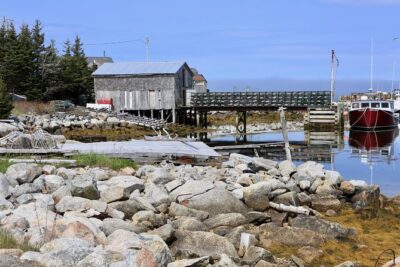
Browse the lists this tour appears in